
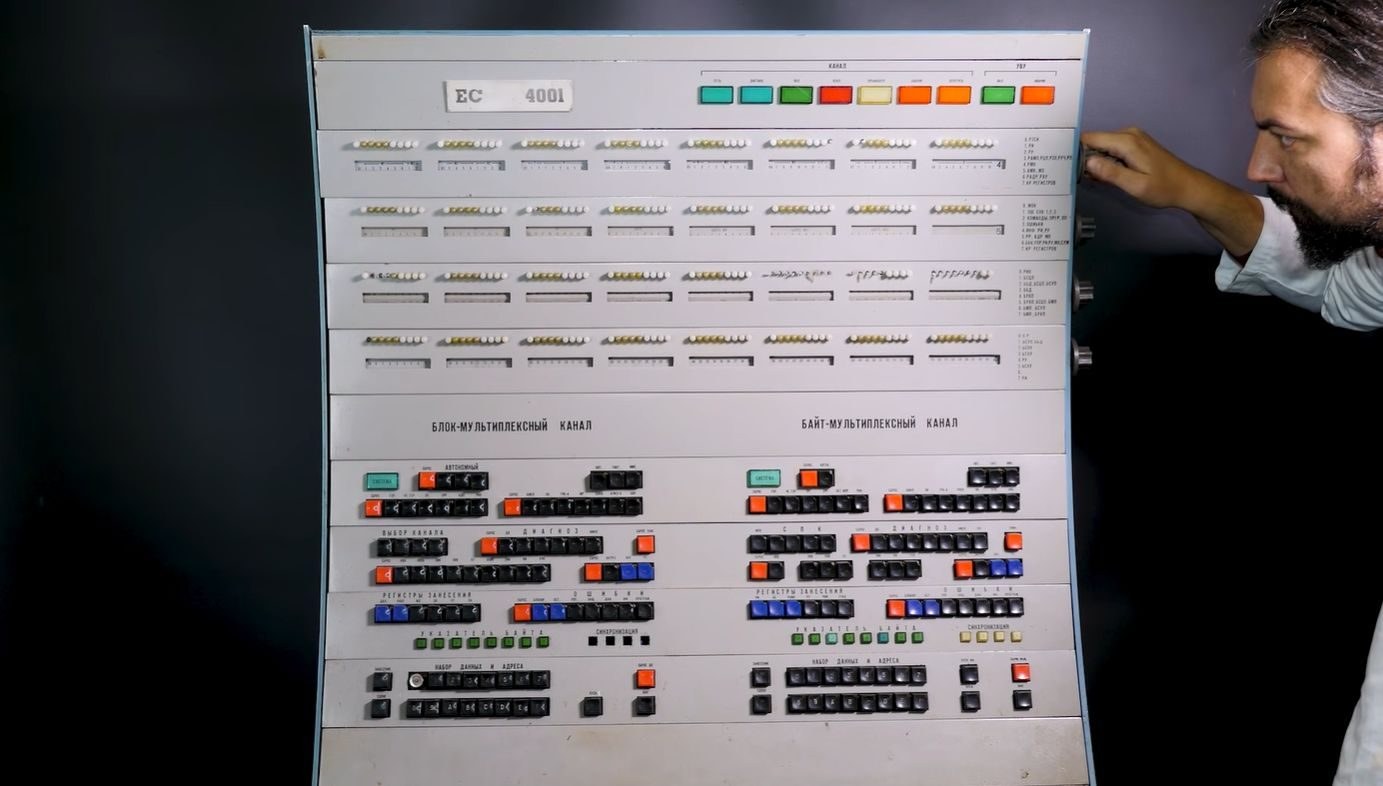
 he enthusiasts behind the Chornobyl Family collective have managed to secure a control panel from a 1970s Soviet ES-4001 mainframe with the goal of bringing the hardware fully back to life. Today, consumers have grown accustomed to swapping smartphones every two years, discarding devices outfitted with glued-shut casings and software tethered to recurring subscription models. Back in the 1970s, however, the underlying approach to engineering hardware was radically different, and these hobbyists are proving it on the workbench by resurrecting technology that is half a century old.
This undertaking sits atop a massive era of computing history. During the 1970s, Soviet planners operated under the conviction that the country could not fall behind in the race to build advanced digital computers. That pressure fueled the development of original domestic designs alongside extensive reverse engineering of American architectures like the IBM System/360 and System/370. The resulting ES computer series produced systems such as the ES-1060, one of which was famously deployed directly beneath the massive arrays of the Duga-1 over-the-horizon radar installation.
The Chornobyl Connection and Surviving Hardware
That specific computing hub sat right under the shadow of the Duga-1 radar antennas near the Chornobyl Nuclear Power Plant in Ukraine. Yet that particular mainframe never entered full operational service following the disaster at the plant's fourth reactor. All that remained of a once-pinnacle achievement of Soviet engineering at the site was a gutted computer frame and its detached control console.
The specific control panel recovered by the enthusiasts dates back to the early 1980s and spent its working life in the far more forgiving environment of a standard data center, allowing it to survive in relatively good condition. Even so, the restoration required substantial effort: the team had to return the electronics to a working state while repairing the physical scars left by a rough, hurried extraction from the original mainframe chassis. Soviet industry built roughly 300 of these large mainframes in total, leaving modern restorers to carefully preserve every surviving module alongside fragile paper documentation.
What This Means for Your Wallet
The modern electronics market has trained consumers to accept that hardware dies alongside its battery or the moment a manufacturer drops operating system updates. When a brand glues a chassis shut and blocks third-party component swaps, it effectively manufactures planned obsolescence to force a hardware upgrade every three years. The return to repairable machines from the 1970s serves as a blunt rebuke to an industry built on disposable plastics and sealed enclosures.
For anyone tired of replacing expensive hardware simply because engineers chose not to design it for longevity, these Soviet relics offer a stark contrast. Manufacturers pitch annual smartphone upgrades as cutting-edge innovation, yet they routinely strip away the fundamental right to repair and maintain what you own. The painstaking effort required to rescue these forgotten machines demonstrates that real technological value lies in durability and serviceability, not in the relentless cycling of model numbers.
Editorial analysis
We covered this earlier
On 10 September 2026, a builder created a fully functional 8-bit machine called The Tube Computer (MK3), powered by 460 vintage Soviet 6N3P-EV double triode vacuum tubes and 1950s-style germanium diodes. Now, enthusiasts from the Chornobyl Family community have acquired a control panel from a 1970s Soviet ES-4001 mainframe with the goal of restoring the hardware to working order. It looks like the focus of independent workshops is shifting from custom vacuum-tube builds to the restoration of complete large-scale computing systems from half a century ago.
Sources: our stories of 10.09.2026