
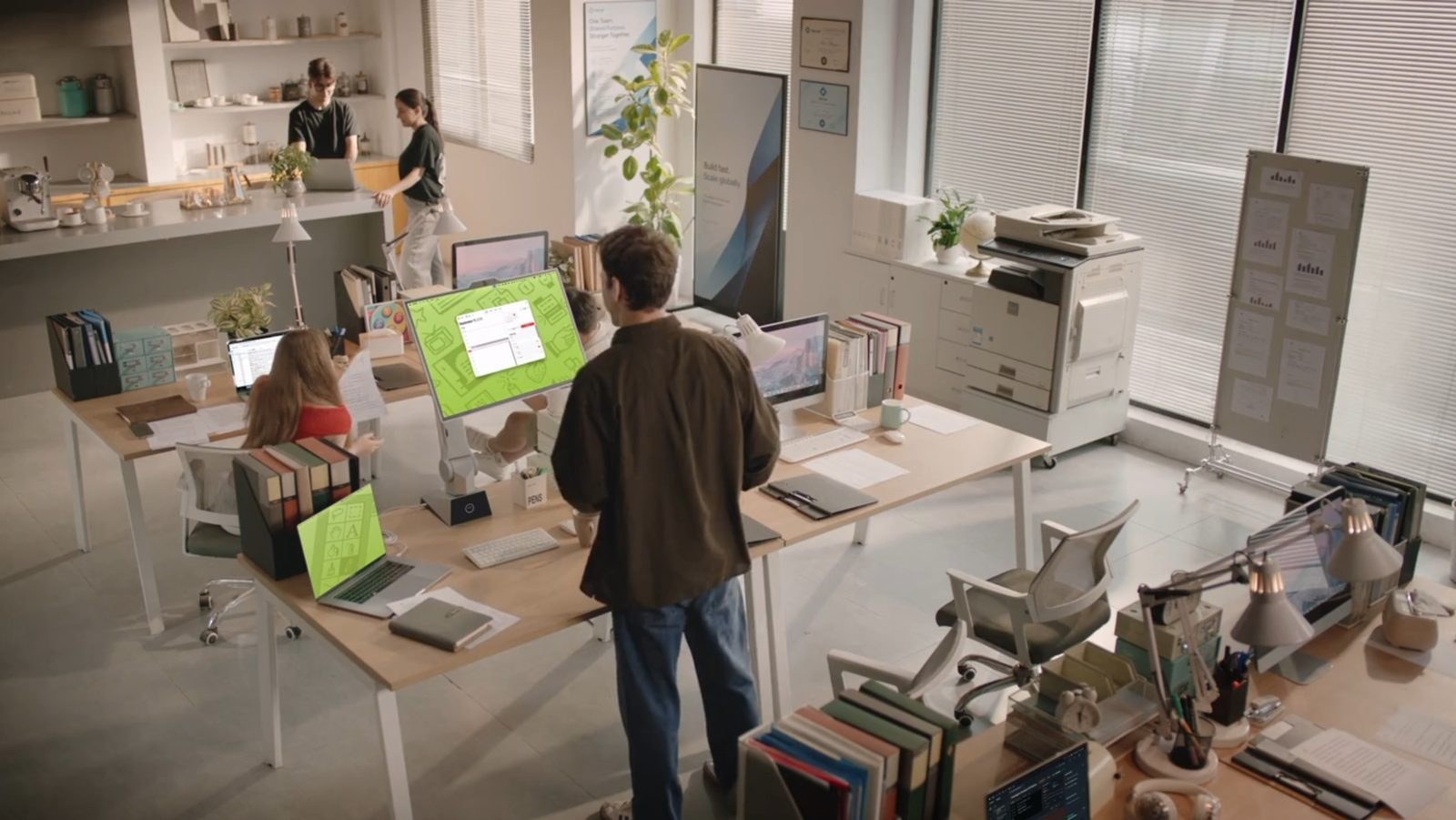
 onitor arms have spent decades doing one job: holding still. CyboPal's answer challenges that premise in an intriguing way. The Kickstarter-funded CyboPal ONE bolts a 27-inch 4K display to a six-axis robotic arm that clamps to your desk, keeps an eye on where you are, and moves the screen to match—whether you are hunched over a keyboard, standing, or leaning back to read. According to TechRadar, the Super Early Bird price for the CyboPal ONE on Kickstarter starts at $1,599, converted from HK$ 12,536. This price reportedly holds steady even if you order up to five units, though only the first 300 single-unit orders benefit from the current markdown.
The $1,599 price is the Super Early Bird price, converted from HK$ 12,536 on the same site.
The steep price hasn't stopped backers from piling in by the bucket. Kickstarter showed the campaign—scheduled to close on November 21, 2026—at just over 11,000% of its HK$80,000 goal, pulling in roughly HK$8.8 million (about $1.1 million), as TechRadar points out. That tally includes about 255 visible backers, though BackerClub's tracker counts more than 450, likely including those who paid a $30 deposit to lock in an earlier $1,499 rate. As noted in the coverage, CyboPal claims its face-tracking system repositions the screen in under four seconds, while a binocular 3D sensor handles obstacle avoidance and path planning.
Built-In Compute Base
The ONE also carries its own computer. CNX Software lists an eight-core Rockchip RK3588 with a 6 TOPS NPU, 8GB of RAM, and 128GB of storage, housed in what CyboPal calls a Linux AI Compute Base. According to TechRadar, this onboard hardware handles face tracking, gesture recognition, and 3D spatial sensing locally. The campaign pitches the ONE as a companion to the computer you already own, tying voice control, robotic motion, and the full feature set to a USB-C link that can also charge your machine at up to 65W. The Pauli voice agent runs via a CyboPal desktop client for Windows, macOS, and Linux, and an HDMI 2.1 input lets compatible phones and tablets use the panel as an external display.
While the onboard RK3588 acts as the robot's brain, you still need a proper laptop or desktop to get actual work done. CyboPal founder and CEO Frederic Peng argued in the launch announcement that AI should fundamentally change what a computer is. CyboPal states that face tracking brings the screen into position within a 747mm reach. Tracking is just one mode among several: users can also recall saved positions, tell the screen to come closer, back off, rotate, or switch to portrait mode. Gestures let you move the screen and scroll content, and a firm tap on the desk stops the arm dead in its tracks.
Gamble on Software
CNX's spec list assigns the separate HDR camera to spatial awareness, path planning, and obstacle avoidance, with the campaign describing 3D sensing as the mechanism that spots desk clutter and stays within preset boundaries. CyboPal bills the ONE as the world's first desktop robotic terminal—a category label of its own invention—and claims mass production is already underway. The planned retail price sits at $2,499. Beyond fidgety desk workers, the hardware could theoretically cater to users with limited mobility, with Gizmodo Japan suggesting it might even find a second life as a medical tool.
Whether that enthusiasm pans out into a tangible product that delivers on its promises remains an open question. At $1,599 now and $2,499 later, backers are paying for a monitor, an articulating arm, and a heavy bet on unproven software that hasn't survived independent testing. It makes for an exceptionally expensive, albeit fascinating, gamble.