
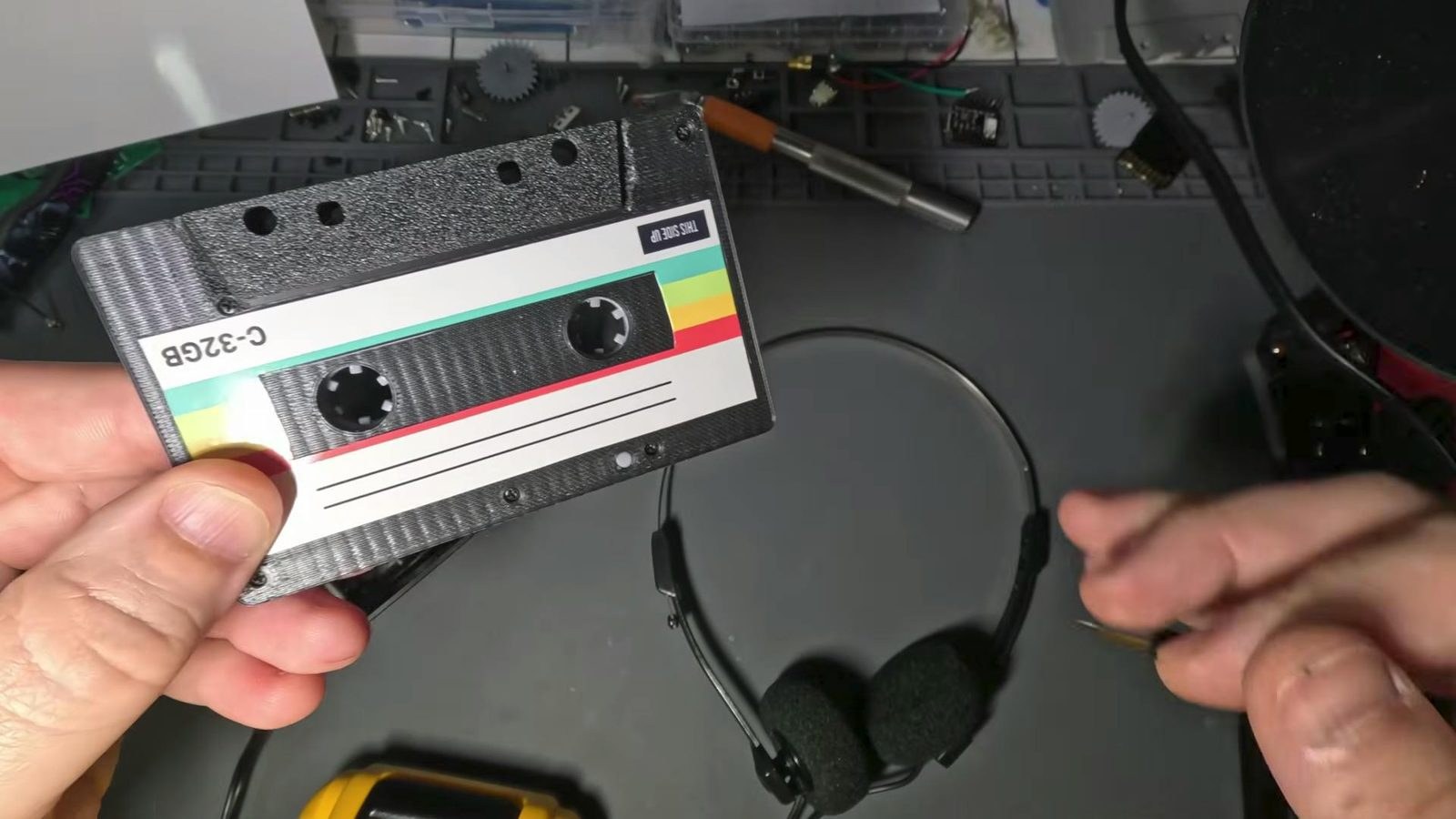
 ape adapters used to mean dangling cables and cheap plastic shells that let you pipe sound from a CD player into a vintage car stereo. Jonathan Rowny took that setup to its logical extreme by building an entire standalone, battery-powered MP3 player inside an ordinary cassette shell. It is a brilliant piece of engineering stubbornness that completely bypasses modern touchscreens in favor of physical hardware you can actually feel.
He built a complete battery-powered MP3 player inside a cassette shell, but instead of having its own headphone jack or speaker, it can only play music when inserted into a working tape deck.
The contraption produces sound exclusively when slotted into a functioning vintage cassette player. To push audio across the physical barrier without wires, Jonathan Rowny salvaged a stereo tape head from an inexpensive adapter and wired it in reverse. Signals from a dedicated PCM5102A DAC chip feed the coils inside the head to generate a localized magnetic field, which the playback head of the tape deck picks up and reads as standard audio tape.
Custom Engineering Packed Into One Millimeter
Fitting a modern digital sound system into a classic shell required shrinking every core component down to the millimeter. The core processing runs on a Seeed Studio XIAO ESP32S3 development board paired with the PCM5102A DAC and a microSD card slot for music files. Power comes from an internal 600 mAh LiPo battery, which Jonathan Rowny states delivers roughly 10 hours of continuous music playback. To prevent accidental power drain, a physical button puts the ESP32-S3 microcontroller into deep sleep, letting the battery hold its charge for months on a shelf.
Space was so constrained that Jonathan Rowny designed a custom two-layer PCB that measures just 1 mm thick. The device must also detect the exact moment a listener presses Play on the deck's mechanical controls. To handle that trigger, Jonathan Rowny designed a three-gear mechanism linking the cassette's two take-up sprockets. The center gear sports a tiny 1.7 mm hexagonal shaft that locks into a 2-mm-thick rotary encoder mounted directly to the circuit board. Because standard 3D printers could not reliably form such small hexagonal shafts, Jonathan Rowny resin-printed the gears at a 30-micron layer height to ensure the mechanical parts mesh cleanly without binding.
Digital Convenience with Mechanical Tactility
Loading music onto the DIY cassette avoids tedious cable swapping thanks to onboard wireless networking. The ESP32-S3 microcontroller hosts its own Wi-Fi web interface, letting you connect from a phone or computer to upload MP3 files and organize tracklists directly over the air. Once loaded, the playback experience relies entirely on the heavy physical clunk of a classic deck rather than tapping a touchscreen.
Hardware projects like this show how custom microelectronics can seamlessly upgrade legacy audio gear without stripping away its mechanical charm. Instead of throwing out aging car stereos or boomboxes, clever component integration turns obsolete tape mechanisms into modern wireless-fed sound systems, proving that sometimes the best way forward is building backward.