
 trict flight time limits mean a standard drone lasts barely twenty to thirty minutes before freezing temperatures drain its battery. When an aircraft needs to conduct prolonged surveillance in harsh field conditions, operators become trapped in an endless cycle of battery swaps. Hovering in place pushes the motors to their limits, and finding a landing spot in an icy desert is often impossible amid sheer walls and slick icebergs.
Grip without extra motors
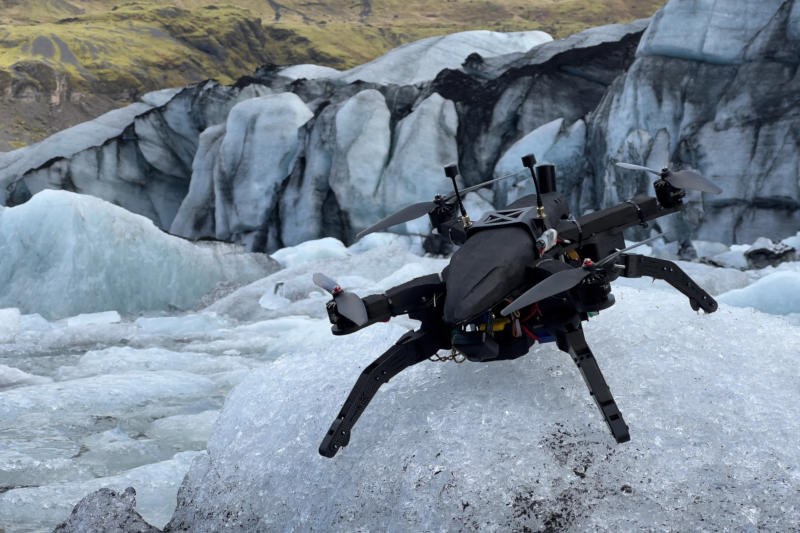
Engineers took their cue from nature. As reported by 3DNews, researchers developed a landing mechanism for drones featuring "cat claws." Instead of adding bulky hydraulic grippers and overloading the airframe with electronics, they equipped the craft with biomimetic grapples. The mechanism directly mimics wild cats: sharp elements dig firmly into micro-cracks along vertical ice surfaces, securing the entire structure using pure geometry and passive mechanics.
In plain terms, the drone no longer needs to fight gravity with its rotors to stay in one place and monitor a target. It simply flies up to an icy cliff, digs its paws in, and kills the engines.
Drones with grippy mechanical claws can latch directly onto icebergs and steep ice cliffs, completely cutting motor power.
Once the rotors shut down, the primary power drain vanishes instantly while the drone stays anchored to the sheer wall. The battery only feeds the camera and sensors, turning a meager charge that would otherwise last minutes into hours or even days of uninterrupted surveillance.
From flying toys to sentinel outposts
This is a rare case where an unconventional form factor solves a core endurance bottleneck without relying on experimental battery chemistry. A conventional quadcopter expends most of its energy simply keeping its own weight aloft. A straightforward mechanical anchor on a vertical surface turns a fragile flying drone into a static watchtower capable of holding out against wind and sub-zero temperatures for days.
Consumers probably will not see this tech on holiday camera drones tomorrow, but the principle points the industry in a fresh direction. Instead of chasing marginal battery gains, engineers are reinventing field deployment in environments where regular landing is out of the question.
Biomimetic claws transform a short-lived flying camera into an autonomous vantage point anchored directly onto ice walls. Passive mechanical gripping removes the load from the battery, enabling hours of reconnaissance without heavy motors. In the coming years, this approach will free rescue and research drones from constant tethering to landing pads and field generators.