
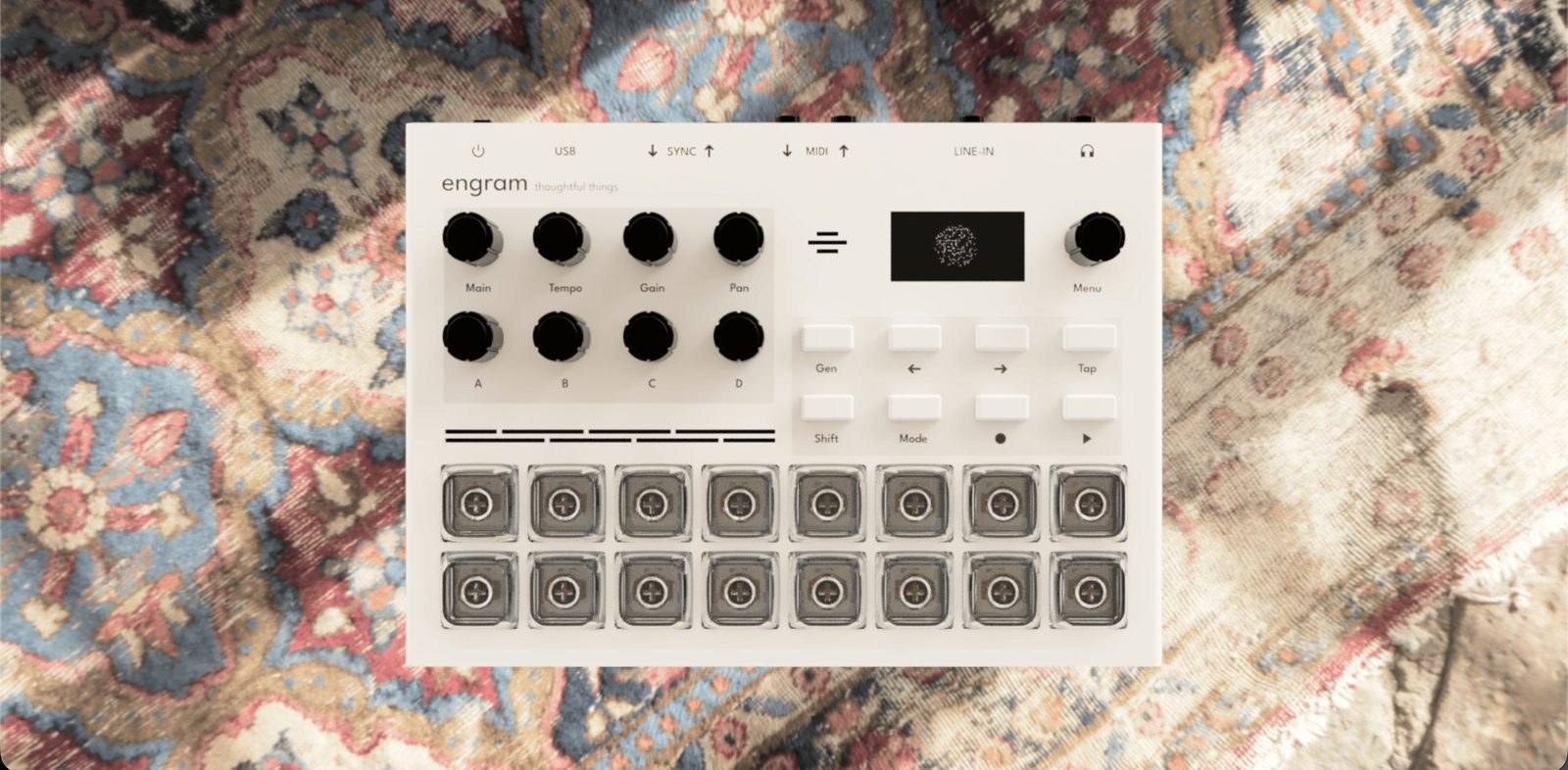
 f you are exhausted by cloud platforms promising polished, radio-ready tracks at the click of a button, you are hardly alone. Music startup Thoughtful Things has launched a Kickstarter campaign for Engram, its first standalone instrument, taking a sledgehammer to the prevailing industry consensus on synthetic audio. Instead of renting compute cycles from a remote server to generate sterile pop arrangements, this little hardware box turns broken machine learning hallucinations into tactile, lo-fi noise right on your desk.
Engram operates strictly as a standalone sampler and groovebox designed to mangle incoming audio signals and generate gloriously unpredictable textures. The device refuses to connect to the internet entirely, running a tiny custom artificial intelligence locally on its own silicon.
Engram isn't connected to the internet. Instead, it runs a "tiny AI" locally.
That complete offline independence means zero subscription fees, no corporate platform lock-in, and none of the latency or privacy compromises inherent to cloud-based processing.
Local Latent Space and Open Code
Under the hood, the internal setup bypasses conventional generative pipelines in favor of immediate hands-on control. As detailed in the Kickstarter listing, the audio model is custom-trained and designed entirely in-house. Thoughtful Things trained its audio models exclusively on open datasets containing commercially licensed audio, neatly dodging the copyright minefield of scraped web data. In the campaign video, founder Evan King uses his voice to ask for a simple piano sound, and Engram spits out a glitchy, degraded digital approximation instead of a clean acoustic instrument. Thoughtful Things also plans to open up the device firmware, letting tinkerers tweak its code or load their own custom models.
The Price of Chaos
Physical independence and custom neural silicon do not come cheap. Thoughtful Things is launching with a limited run of hardware for early Kickstarter backers starting at $675. That early pledge represents a listed 30 percent discount, which pushes the expected retail price to somewhere between $850 and $900 once general availability begins. Dropping high-end synthesizer money on an experimental box built deliberately to generate unpredictable glitches is a remarkably tough sell for casual hobbyists. Yet for sound designers who want a physical tool for exploring machine learning latent space rather than yet another subscription web dashboard, Engram proves that turning neural network failures into tangible hardware is a genuinely viable product category.