
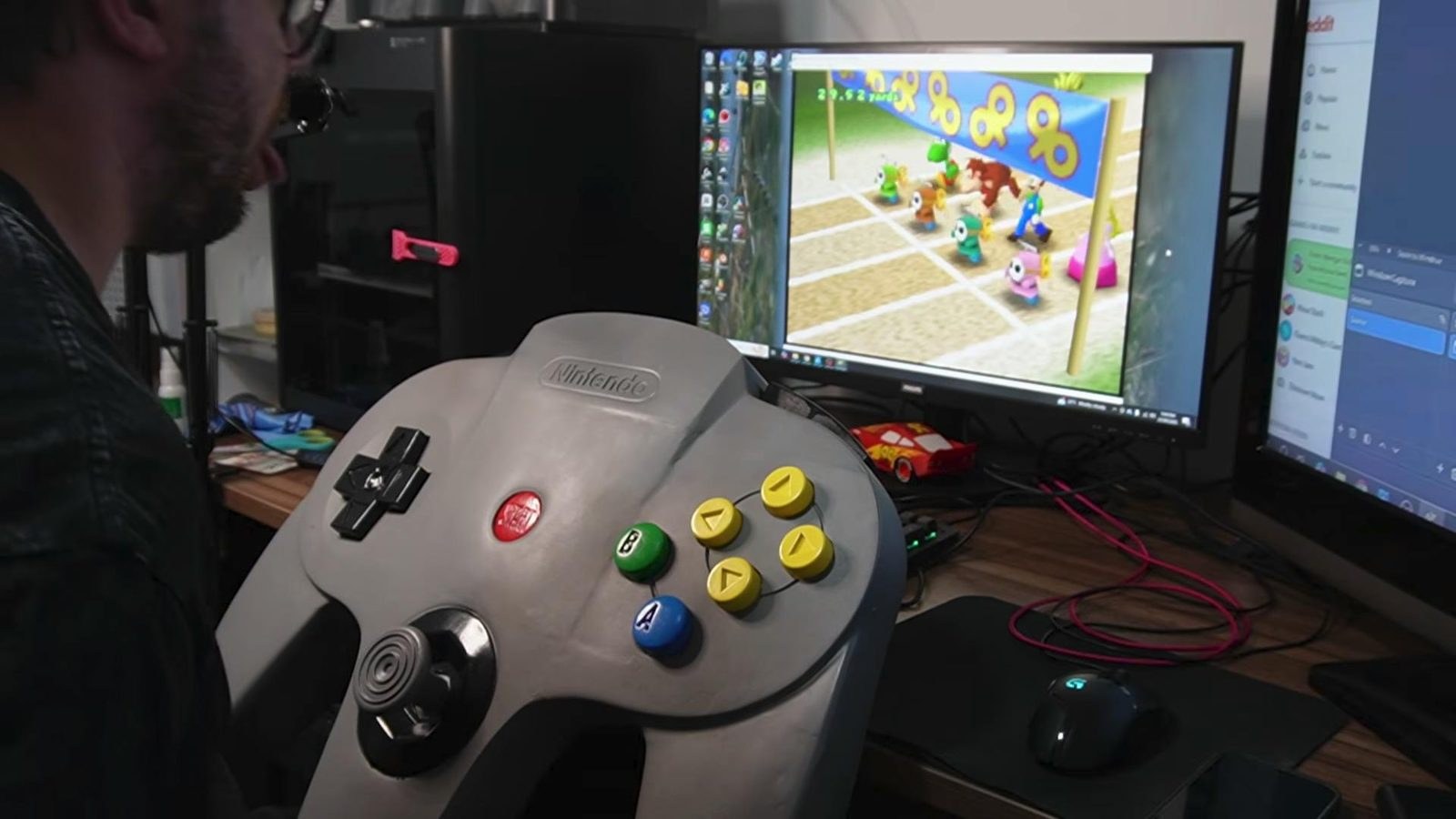
 hen a standard plastic gamepad no longer satisfies your desire for physical inconvenience, the only logical step is to build an oversized replica that completely ignores human anatomy. As ChaosBench demonstrated, the obvious solution was to make a classic peripheral far harder to use by building a gigantic, fully functional version of the Nintendo 64 controller. Instead of relying on traditional manufacturing lines, the project began with a digital 3D model of a standard Nintendo 64 controller, hollowing it out in Meshmixer before slicing the enormous shell into pieces small enough to fit on standard 3D printers.
Building a giant replica requires considerably more engineering grit than simply scaling up a digital file. The sections were printed in PLA and joined together using plastic welding and super glue. Making the collection of separate plastic parts look like a single injection-molded shell took some additional labor, so automotive body filler covered the seams before everything was sanded, primed, and painted in the familiar N64 gray. As ChaosBench noted, the filler didn't adhere perfectly to the PLA, resulting in a few surface cracks and chips, but the finished controller still looks surprisingly convincing.
The Mechanical Nightmares of Scaling Up
At the scale of this controller, even basic buttons turned into a formidable engineering hurdle. To make the unit functional, ChaosBench designed custom assemblies that place microswitches underneath the 3D-printed buttons. Anti-rotation guides keep the buttons properly oriented so their recessed letters and symbols don't spin around inside the shell. Early versions of the buttons had a stubborn tendency to bind in their openings. After ChaosBench adjusted the tolerances by fractions of a millimeter, it became clear that the microswitches themselves still weren't strong enough to reliably push the massive buttons back up. Heavy-duty springs solved that problem, at the steep expense of requiring a punishing amount of physical force to press them.
Heavy-duty springs solved that problem, at the expense of requiring a lot more force to press them.
Inside, the electronics are straightforward. Each microswitch connects to a zero-delay USB encoder, which converts button presses into signals that a computer reads as coming from a standard USB gamepad. Because of the controller's absurd dimensions, the included wiring harnesses weren't nearly long enough, forcing ChaosBench to fabricate custom extension cables using crimped connections and heat-shrink tubing.
Compromises in Playability
A few severe ergonomic compromises had to be accepted during the build. Mario Kart 64 works reasonably well with the setup, although holding down its giant accelerator button quickly turns into a genuine workout.
The oversized controller works with N64 games running on an emulator, though playing them takes quite a bit more effort than with an original controller.
Button mashing is practically out of the question thanks to those stiff, heavy springs. If straightforward ease of use is what you are after, you should obviously stick with a regular-sized controller. If you want something absurd to show off to your friends, then ChaosBench's creation hits the mark.
This garage project proves that independent engineering can recreate almost any classic form-factor, even when the resulting physical object actively fights human physiology. You will not replace your daily setup with a giant plastic pad that demands serious physical exertion for basic inputs. ChaosBench built a monument to absurdity that works just well enough to remind you why controllers shrank in the first place.