
 f you run a desktop 3D printer, post-processing is where the hobby turns into a tedious chore. Smoothing visible layer lines with sandpaper eats hours, coats your room in fine plastic dust, and demands serious elbow grease. While industrial sandblasting strips layer lines in seconds on factory floors, conventional blast cabinets are massive, leaky iron boxes that belong in an auto shop, not an apartment. Startup GritPlex wants to shrink that finishing step into a closed desktop appliance that sits comfortably next to your printer.
A Three-Stage Sealed Setup
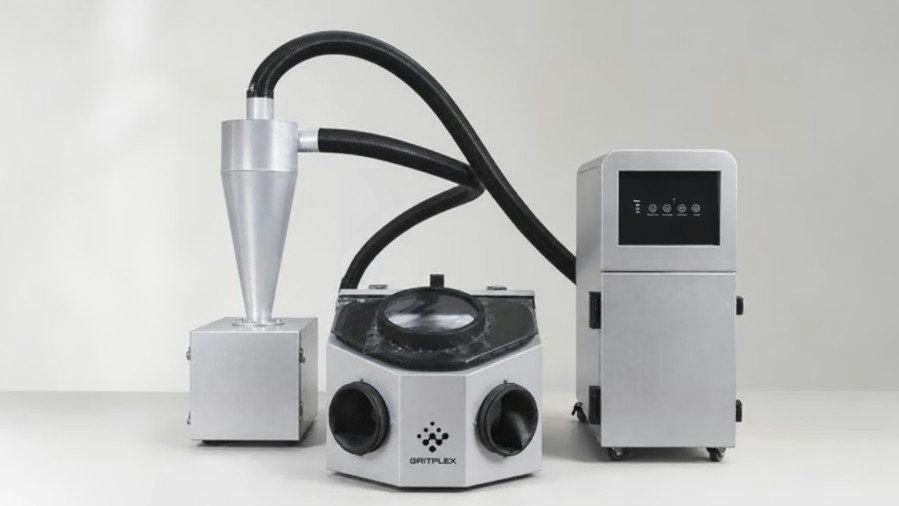
The setup centers around the GritPlex Core, an enclosed workstation with integrated heavy-duty gloves, a viewing window protected by cheap peel-off film, and twin blasting pens designed to swap between abrasive media. But putting pressurized media in a living room requires serious containment, which is why GritPlex built a three-stage sealed loop: the blasting box, the SpinX cyclonic separator, and a dedicated negative-pressure vacuum.
"Industrial sandblasters are massive, leaky iron boxes that scatter abrasive dust everywhere."
As founder Sal Sun noted, safe desktop alternatives have been essentially non-existent for home makers. The vacuum holds the chamber under constant negative pressure so micro-dust cannot blow out of the seams, while the cyclone traps the bulk of the abrasive for reuse before it ever touches the filter. When blasting is overkill, the chamber doubles as a contained box for rotary tools and hand carving without scattering plastic shavings across your desk.
The Crowdfunding Math and Reality Check
The pricing demands careful reading before you pledge. While the bare Kickstarter Core starts at $549, that entry tier is essentially an empty box. Getting the complete, sealed indoor loop requires the full $899 bundle, which packages the Core, the SpinX cyclone, the vacuum, 10kg of blasting media, replacement filters, and 100 window films.
GritPlex targets delivery for October. Spending $899 to reclaim dozens of sanding hours makes mechanical sense if you finish parts regularly, though standard crowdfunding caveats apply: first-time hardware runs routinely face manufacturing hiccups before reaching customer hands.