
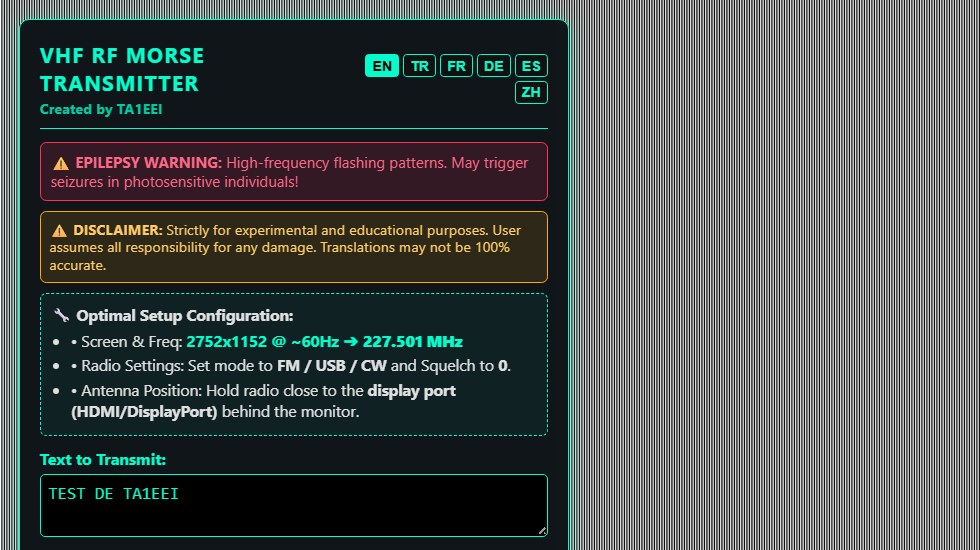
 ou do not need dedicated radio gear or a hacked Wi-Fi chip to beam wireless signals out of an offline room. As hardware tinkerer Efe recently demonstrated, an everyday monitor, a video cable, and a lightweight browser script are all it takes to turn an ordinary desktop setup into a functional VHF radio transmitter.
The exploit hinges on deliberate pixel clock manipulation. Whenever your graphics card refreshes a frame, rapid voltage swings across the HDMI or DisplayPort cable generate unintended electromagnetic leakage—an effect known in intelligence circles as TEMPEST radiation. By aligning the total pixel grid with the refresh rate, you can tune this radiation to a predictable frequency. For example, driving a standard 1080p display at 60 Hz under the CEA-861 standard requires a total resolution of 2200 by 1125 pixels once blanking intervals are included. Multiplying those values by 60 Hz forces the video pipeline to pulse at exactly 148.500 MHz—right inside the VHF band.
From there, Efe's script rapidly alternates specific black and white pixel patterns across the screen, turning the display cable into an impromptu antenna that pulses Morse code over the air. While modern monitor cables carry shielding designed to choke stray interference, enough parasitic radiation leaks out to be picked up by a nearby software-defined radio.
Broadcasting across unlicensed VHF channels obviously runs foul of radio regulations, but the real issue here is the air-gap bypass. Even on a machine completely disconnected from the internet and stripped of wireless cards, opening an innocuous offline webpage can trick the display hardware into leaking sensitive data directly through the air.