

 our old smartphone is currently sitting in a drawer, depreciating into digital junk while you wonder why upgrading to the latest model costs as much as a used scooter. Researchers at UCLA have found a remarkably practical use for that electronic clutter by turning an ordinary Android device into the literal brain and sensor suite of a two-legged robot.
If you have ever looked at the soaring prices of hobbyist robotics and wondered why building a simple machine requires emptying your savings account, this project is the direct answer. Instead of buying expensive specialized computers and sensors, the system relies on hardware you likely already own, cutting the cost of building a 19-inch, four-pound humanoid robot down to approximately $400 for the mechanical chassis and motors alone.
Building a robot from spare parts
The machine itself, dubbed PhoneBot by the research team, is surprisingly nimble for a cobbled-together science project, standing approximately 19 inches tall and weighing four pounds. It does not have arms or a head, but it can walk on two legs, track people with its camera, and get back on its feet after falling down.
The lower body relies on 12 degrees of freedom, featuring three joints at each hip, one at each knee, and two at each ankle. A thirteenth joint rotates the torso, allowing the smartphone's camera to track objects without moving the robot's feet. All 13 joints are driven by inexpensive DYNAMIXEL XL430-W250-T servo motors.
PhoneBot stands approximately 19 inches tall, weighs four pounds, and costs around $400 to build, excluding the smartphone.
The smartphone sits snugly in a mount right above the hips, acting as the primary computer and sensor hub. The built-in inertial measurement unit monitors body orientation and movement, while the camera handles object detection, human tracking, and visual navigation. A custom Android application runs the movement and control neural networks using TensorFlow Lite, communicating over Wi-Fi with a small onboard computer that relays commands to the servos.
Why old hardware actually works
You might assume an ancient phone would choke on neural networks and balance calculations, but testing conducted by the researchers tells a different story. The team tested PhoneBot with four Android smartphones, including an Honor 9 from 2017 and three budget models costing approximately $50 to $80 each. All four handled the core functions without a hitch, proving that your old pocket computer packs more than enough processing power for basic robotics.
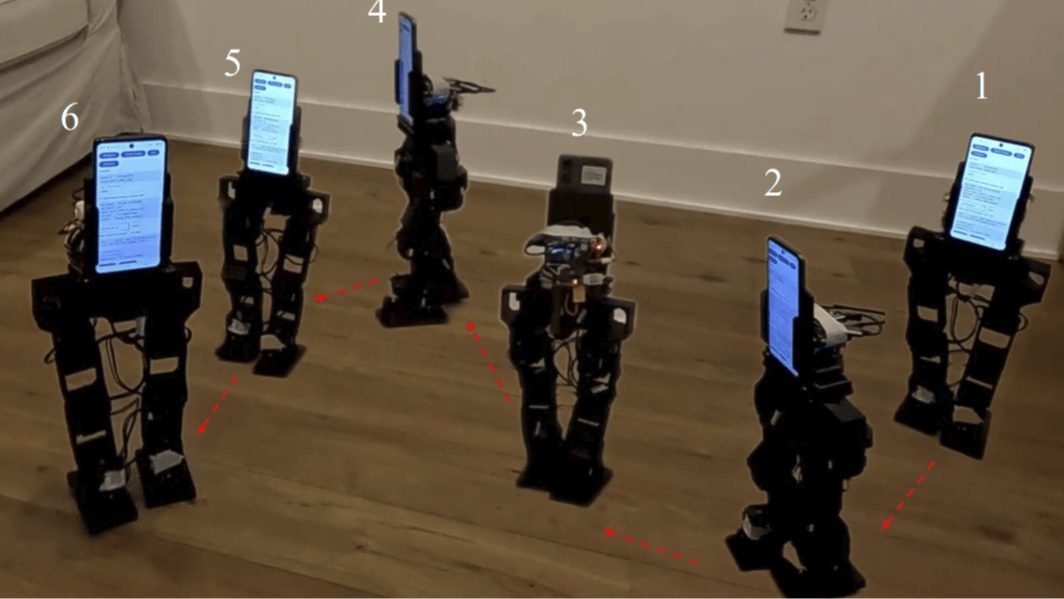
Teaching a cheap humanoid to walk without tumbling over was the real hurdle.
The researchers ultimately decided to use reinforcement learning to train PhoneBot's locomotion controller in simulation, accounting for the limited torque available from its inexpensive motors.
This taught the robot to use both legs equally without requiring additional physics simulations, reducing left-right joint-angle asymmetry from 0.254 to just 0.003 radians in simulation while boosting training speed.
The catch and what it means for you
Before you clear off the workbench, understand what PhoneBot cannot do yet. The walking controller was trained exclusively on flat terrain, and the modest motors severely restrict the payload capacity, meaning you will not be asking this machine to carry your groceries anytime soon. Conversational AI processing also still requires an external laptop rather than running locally on the phone.
Yet for anyone interested in robotics without a corporate research budget, this approach bypasses the most expensive barriers to entry. By routing around costly proprietary electronics and repurposing hardware that would otherwise end up in e-waste, projects like this point toward a much cheaper future for experimental tinkering. Your next robotics project is likely sitting on your desk right now, waiting for a second life.