
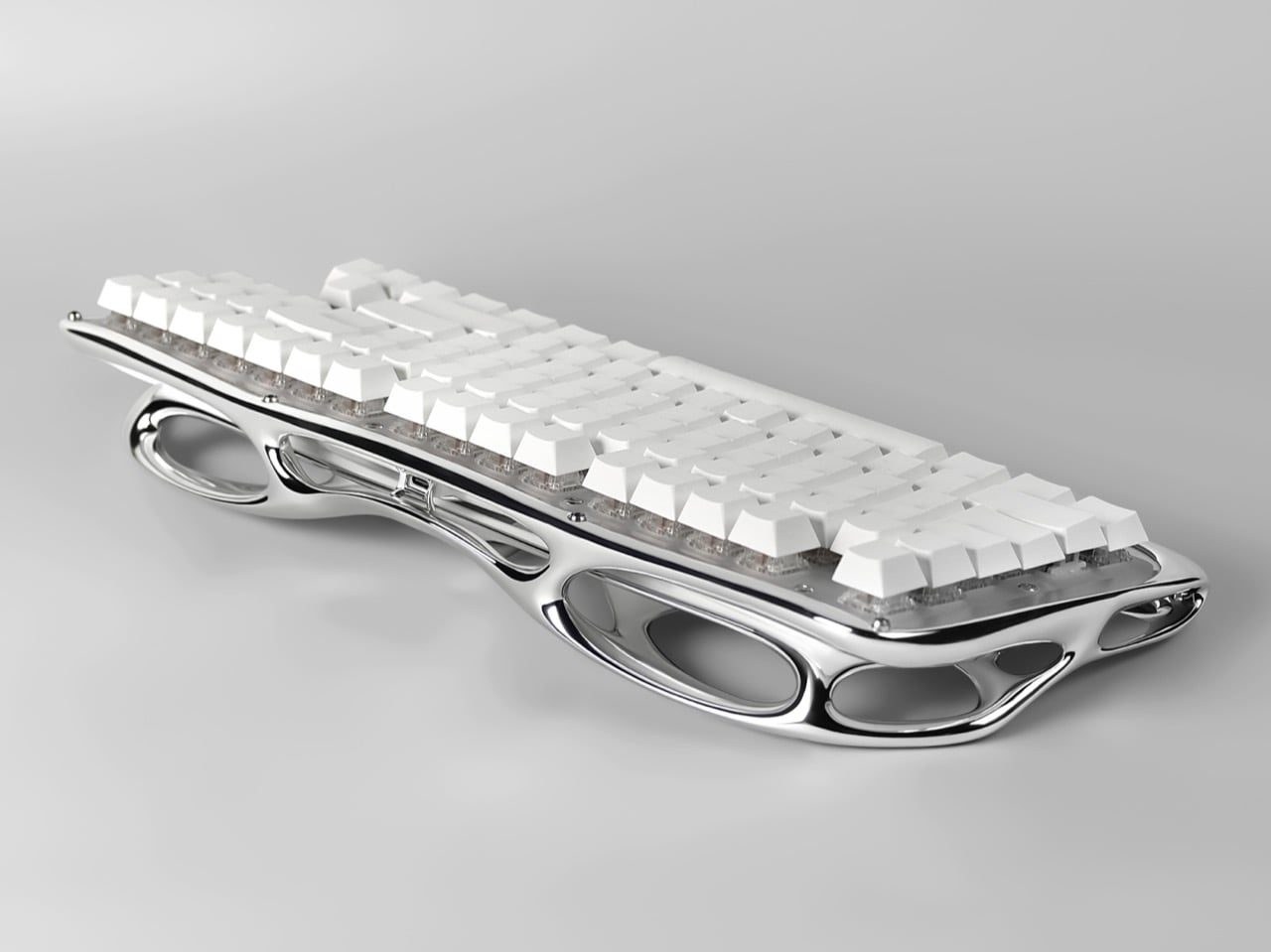
 f you are tired of molded plastic rectangles that look like they escaped from a cubicle farm, the mechanical keyboard market has finally produced something genuinely unhinged. Designed by Haoyuan Lu of New York-based Pulsekey alongside Hongbin Zhang and Wendi Yu, the Pulse One is a wireless mechanical keyboard featuring a 3D metal-printed shell shaped through generative design and digital sculpting. It earned Silver in Consumer Electronics and Computer Accessories at the International Design Awards, and its closest pop culture cousin is the T-1000, the liquid metal assassin from 1991's Terminator 2: Judgment Day. That movie made flowing chrome terrifying, and designers have been borrowing the look ever since, minus the murder. The Pulse One has the exact same mercury sheen, with every curve catching the office light and stretching it into long silver ribbons.
Generative design works by handing a computer a set of structural goals and letting algorithms propose the shape. The software piles material where a structure actually needs it and strips it away where it does not, which is why the results look remarkably organic rather than machine-milled. You can see that exact logic in the Pulse One’s shell, where big elliptical voids sit beside slim, tapering bridges of metal. Lu’s team then refined the form through digital sculpting, turning cold computer logic into something surprisingly graceful. It reads as grown rather than built, much like Dutch designer Joris Laarman’s famous Bone Chair did back in 2006, when he fed a bone growth algorithm into a computer and got furniture that mimicked skeletal growth.
This is the most extra keyboard ever made, and I say that with genuine admiration.
Merging the palm rest, frame, and bezel into a single piece also cleans up one of the messiest corners of keyboard design. Most boards stack a separate case, mounting plate, and wrist rest together, each with its own seams, visible screws, and misaligned tolerances. The Pulse One’s shell sweeps all of that into a single continuous form that cradles the switches and tilts them naturally toward your hands. A few small mounting screws are still visible in the promotional photos, so it is not pure magic, just very tidy engineering. Your wrists get a sculpted metal perch where a cheap foam strip usually lives.
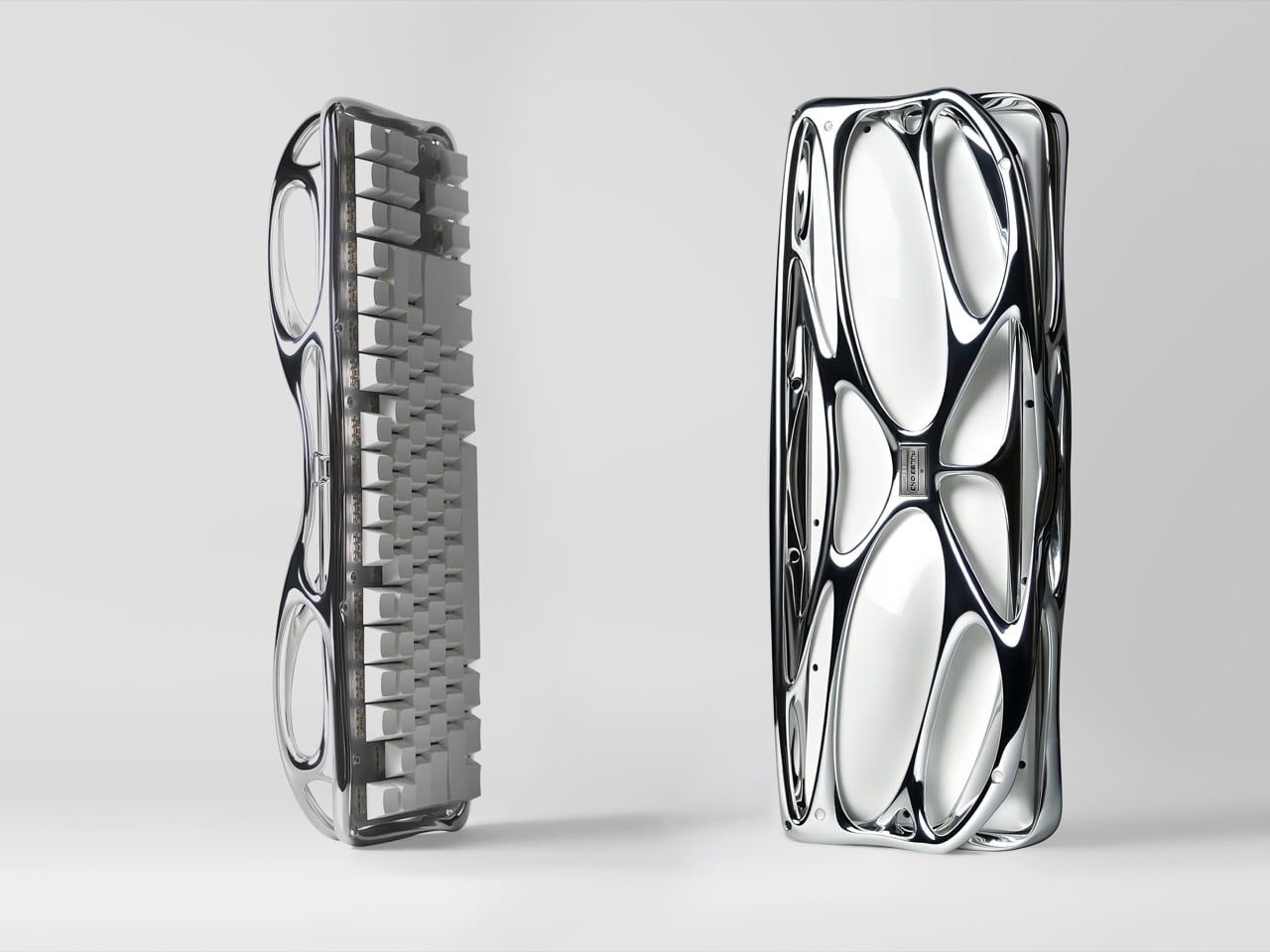
Underneath all that sculpture sits a keyboard people can actually live with on a daily basis. According to the campaign materials, the board is fully wireless, hot-swappable, and capable of lasting for weeks on a single charge. White keycaps float above clear switches, and the hot-swap sockets mean you can pull out a switch and drop in a replacement without touching a soldering iron—a feature explicitly highlighted in the product imagery with a lone switch pulled out beside a stray arrow keycap. The manufacturer also describes the construction as modular, designed for maintenance, customization, and long-term renewal. In practice, it looks like a high-end museum piece but behaves like a tinker-friendly custom board.
Park this skeleton on a wooden desk, however, and your monitor suddenly has a mirror to argue with. If you want a peripheral that doubles as an abstract piece of metal art while keeping the practical perks of hot-swappable switches and decent battery life, this is the exact intersection of high-end furniture design and desktop accessories you probably never knew you were missing. You might not want to outrun it down a hallway, but you will definitely let it sit next to your coffee mug.