
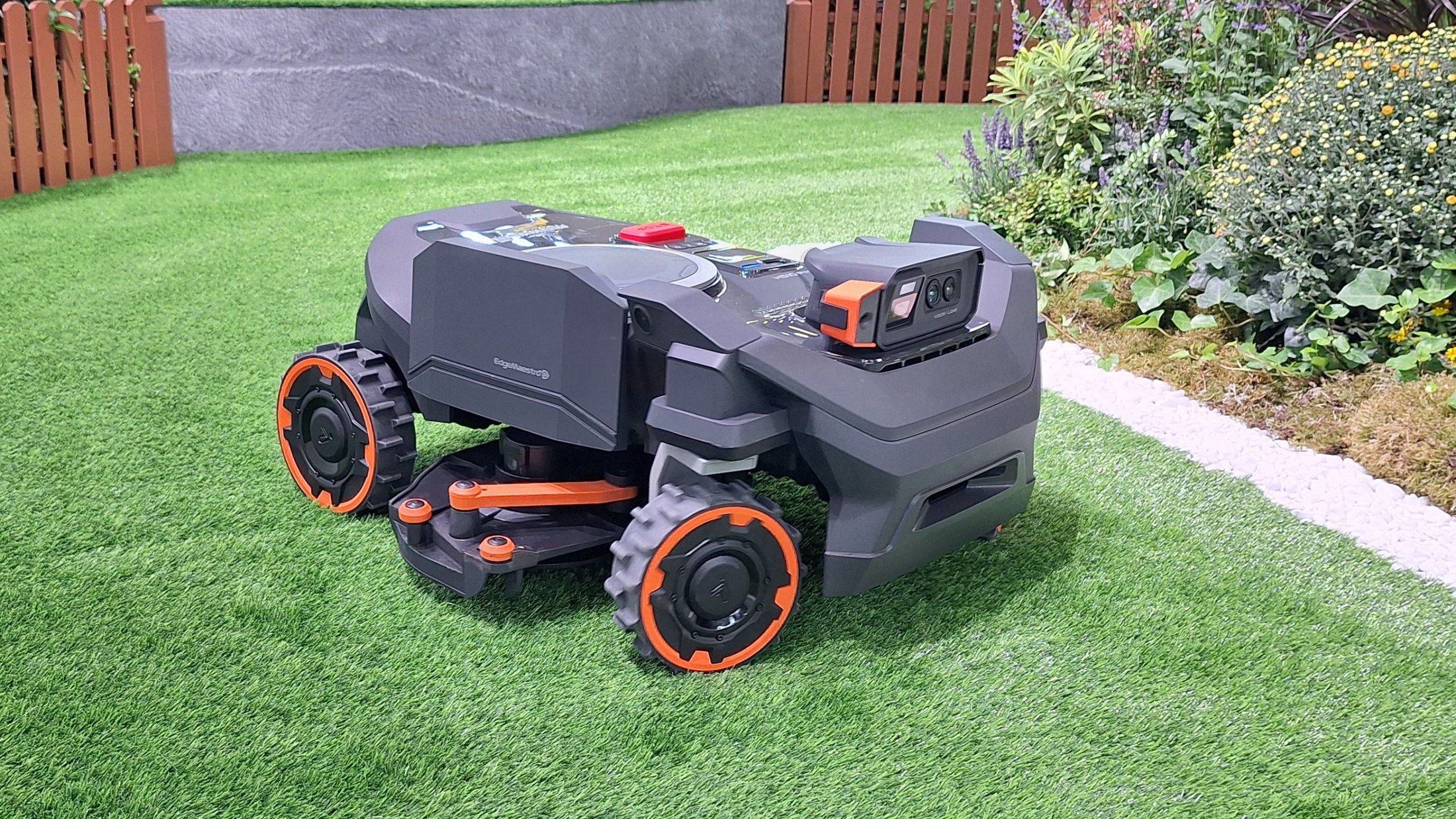
 uying an automated lawnmower usually comes with an unspoken chore: you still have to walk your perimeter every weekend with a manual string trimmer. Traditional wheeled bots simply cannot cut flush against solid fences and patio borders without chewing up their chassis or leaving an untidy strip of missed grass behind. Segway Navimow unveiled its Navimow H510 Pro robotic lawnmower at IFA to eliminate this exact blind spot by mounting the cutting hardware onto an extending mechanical arm.
Instead of relying on compromised offset blades or secondary edge attachments, the Segway Navimow H510 Pro takes its primary cutting deck and pushes it outwards on demand.
The robotic arm on the Segway Navimow H510 Pro mounts the main blade and can reach out by up to 2.9 inches (7.4 centimeters) to mow lawn perimeters.
This physical reach allows the machine to achieve true zero-gap edge trimming. The mechanism is guided by Segway's EdgeSense software, which coordinates how far the arm extends depending on whether it encounters hard edges like concrete walls, soft boundaries like flower beds, or irregular obstacles like patio furniture.
Safety Shields and Turf Protection
Sticking high-speed blades outside a protective plastic shell creates an obvious hazard for backyards with pets or wandering children. To mitigate that risk, Segway added a physical side shield acting as a mechanical barrier against the protruding cutter, paired with active heat-sensing sensors designed to cut power instantly whenever a person or animal approaches.
Navigating tight borders also requires avoiding the turf gouges caused by clumsy zero-point turns. The Segway Navimow H510 Pro deploys Xero-Turn technology, an approach introduced at CES that articulates the wheels to crab-walk around tight bends without tearing up your lawn. The platform operates as an all-wheel-drive machine where each of the four wheels is independently powered and assisted by rear suspension to maintain continuous ground contact across uneven yard dips.
Exposing moving mechanical joints to wet grass clippings, mud, and outdoor grit introduces obvious long-term wear risks that rigid chassis models avoid. Yet for anyone tired of spending thousands on a robot only to finish the lawn manually with a string trimmer, this motorized reach solves the single most annoying practical flaw in automated yard care.