
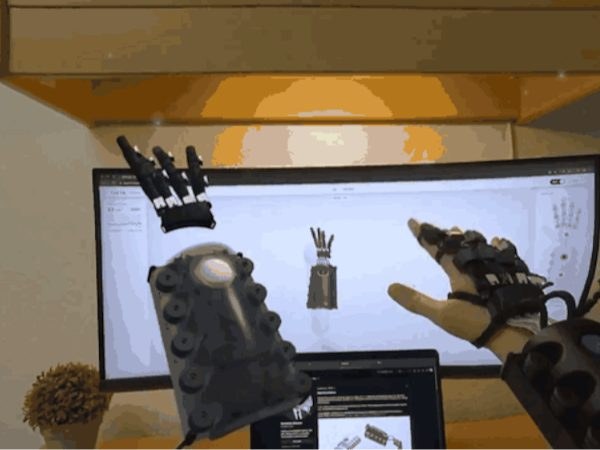
 f you have ever wanted to strap ten motors, a round LCD screen, and a tangle of magnetic encoders to your arm just to practice the piano, engineer Sebastian Molano has a master's thesis waiting for you. Most university degree projects end up gathering dust on a department shelf or turn into half-baked desktop prototypes that barely survive a single demonstration. Molano took a different route at Germany's Anhalt University of Applied Sciences, building a wearable mechanical bracer that actively moves, enhances, and records individual finger movements.
Building a Hand Exoskeleton
The hardware packing list reads like a small robotics laboratory. The device relies on ten motors, dedicating two actuated joints to each of the four fingers and the thumb. A Teensy 4.1 development board coordinates this mechanical hand through a servo bus, gathering position feedback from compact magnetic encoders while auxiliary sensors—including inertial measurement units and a MyoWare 2.0 muscle activity monitor—track what the hand is actually trying to do.
TAKTO ONE is an open source hand exoskeleton.
Software and Features
Hardware is only half the battle, so Sebastian Molano built an entire software suite to accompany the glove, complete with a virtual reality digital twin simulation and control schemes designed to help users compensate for a lack of strength or dexterity.
The system can record physical movements and play them back mechanically. In theory, someone learning an instrument could slip on the device and feel the physical motion of an experienced player moving through a melody, using forced muscle memory to accelerate practice.