
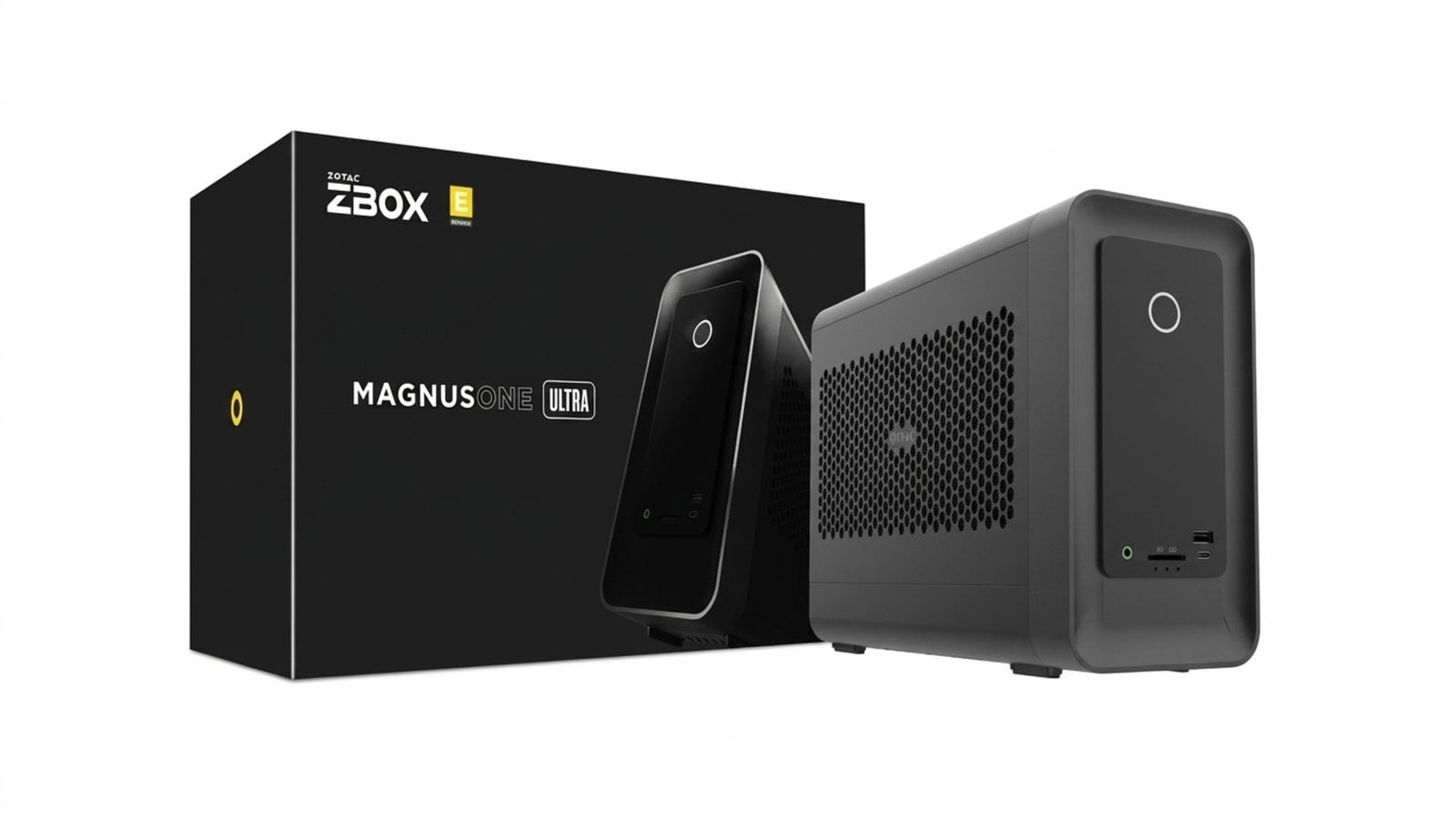
 hen standard desktop towers start to feel like architectural fixtures that demand their own floor space, hardware makers are more than happy to offer you an expensive alternative. This machine is built for anyone who wants high-end gaming grunt without a massive monolith under the desk, though paying twice over for the privilege of miniaturization is part of the deal.
Yet for a starting price of $2,647, what arrives on your doorstep is essentially an architectural shell equipped with an 850W power supply, an Intel Core Ultra 7 265 processor featuring 20 cores clocking up to 5.3 GHz, and a full-fat Nvidia GeForce RTX 5080 graphics card. The barebones version ships completely stripped down—meaning no RAM, no SSD storage, and no operating system.
The entry-level package excludes all three, which means that users interested in this model will have to separately purchase the memory, storage and OS.
As Zotac’s specifications confirm, buyers must source and install all missing components themselves, turning what looks like a ready-to-go purchase into an expensive DIY puzzle.
What is inside and who actually needs it
Beneath the exterior sits genuine Blackwell architecture hardware, ready to handle DLSS 4.5 frame generation, ray tracing, and local artificial intelligence processing tasks.
Zotac Magnus One Ultra’s Core Ultra 7 265 delivers 20 cores and speeds of up to 5.3 GHz
Keeping the system alive requires that 850W power supply, with the graphics card alone drawing a hefty 360W—accounting for roughly 42% of the total energy budget under load. Users can stuff up to 96GB of DDR5 memory across two available slots, while storage duties are handled by a pair of M.2 slots supporting blistering PCIe 5.0 x4 and PCIe 4.0 x4 speeds. Connectivity is remarkably broad, featuring Wi-Fi 7, Bluetooth 5.4, Thunderbolt 4, eight USB ports, plus three DisplayPort 2.1b connections and two HDMI ports capable of driving up to six displays simultaneously.
Is paying extra for compactness worth it
The fundamental dilemma is whether saving desk space genuinely justifies the financial and thermal penalty. Packing a 360-watt graphics card and a 20-core processor into a tight 11.46-liter chassis is an extraordinary engineering feat, but it introduces severe thermal risks and acoustic headaches for whoever sits next to it. Unless office or living room real estate is strictly limited, a conventional full-sized tower remains significantly cheaper, runs much cooler, and lets you swap out individual components without needing miniature tools.
Check local component pricing before committing to Zotac's entry-level shell, as adding the necessary memory, high-speed storage, and a Windows license will push the initial $2,647 starting investment considerably higher.