
 ose your broadband connection, and instantly every map tab, search prompt, and streaming app turns into dead silicone. Maker Michael Klements decided to bypass that grid dependency entirely by building a portable cyberdeck server that hauls an autonomous, offline internet in a single carry case. Rather than tucking a noisy server rack inside a closet, he packaged essential knowledge archives, local web apps, and offline AI models into a rugged field console designed to operate completely severed from the cloud.
The Hardware Inside the Suitcase
Under the hood sits a Beelink SER9 mini PC packing an AMD Ryzen 7 H350 processor, Radeon 860M graphics, 32 GB of RAM, and a 1 TB NVMe SSD. Klements housed the gear inside a custom 3U 10-inch rack enclosure drafted in Fusion 360, which absorbed roughly 60 hours of continuous 3D printing in durable PETG. Because packing dense silicon into sealed plastic invites thermal throttling, three 40 mm Noctua fans sit along an internal partition to actively dump waste heat from the hardware bay.
The machine runs Ubuntu and automatically launches the Project NOMAD dashboard after boot.
The case lid integrates a 14-inch 3K OLED touchscreen linked over a single USB-C cord that passes video, touch telemetry, and bus power simultaneously. Clean electrical design keeps cable clutter down: the entire rig draws power from a single 19 V DC barrel jack. That primary feed powers the mini PC directly, while an internal buck converter steps the line down to 12 V for an embedded QNAP network switch, allowing the mini PC's onboard USB-C ports to supply juice to both the display and a GL.iNet Slate 7 travel router.
Offline Intelligence and Private Networking
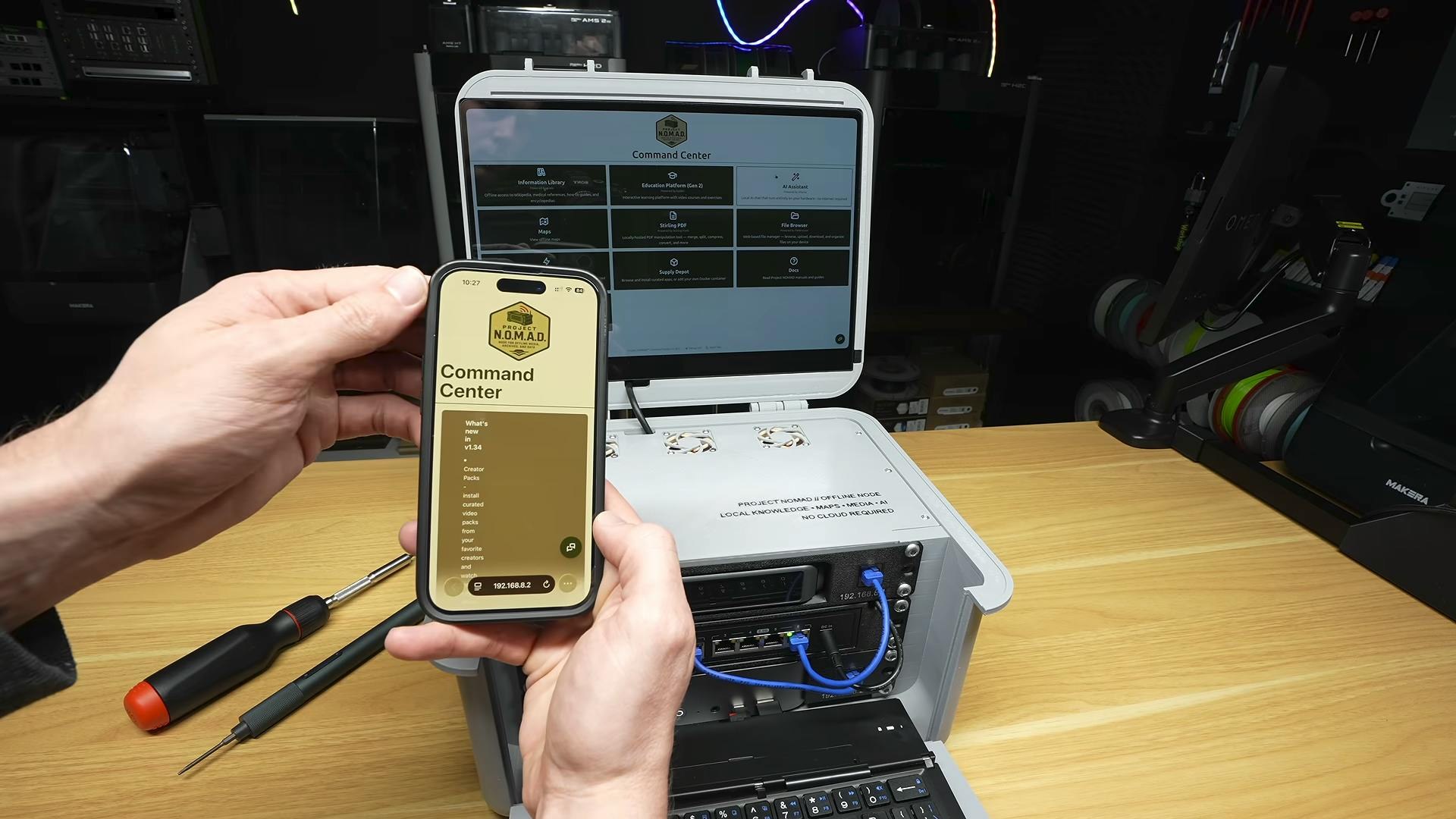
Software management leans on the open-source Project NOMAD suite running atop Ubuntu. Once booted, the local dashboard serves comprehensive offline map packages, complete Wikipedia mirrors, media catalogs, and quantized large language models—including Llama 3.1, Llama 3.2, and DeepSeek R1—without leaking a single telemetry packet beyond the chassis.
The integrated GL.iNet Slate 7 router and QNAP switch instantly project an isolated local Wi-Fi bubble while exposing physical Gigabit ports across the front panel. Any nearby smartphone, laptop, or tablet can jump onto this local hotspot and query offline knowledge bases or run AI inference directly in a standard web browser.
Building a personal digital survival kit requires upfront DIY labor, tailored cooling, and noticeable capital, but it provides total insulation from fragile infrastructure and cloud gatekeepers. Klements proves that with off-the-shelf mini PCs and clever packaging, your mission-critical data and intelligence stack don't have to vanish the second the power lines snap.