
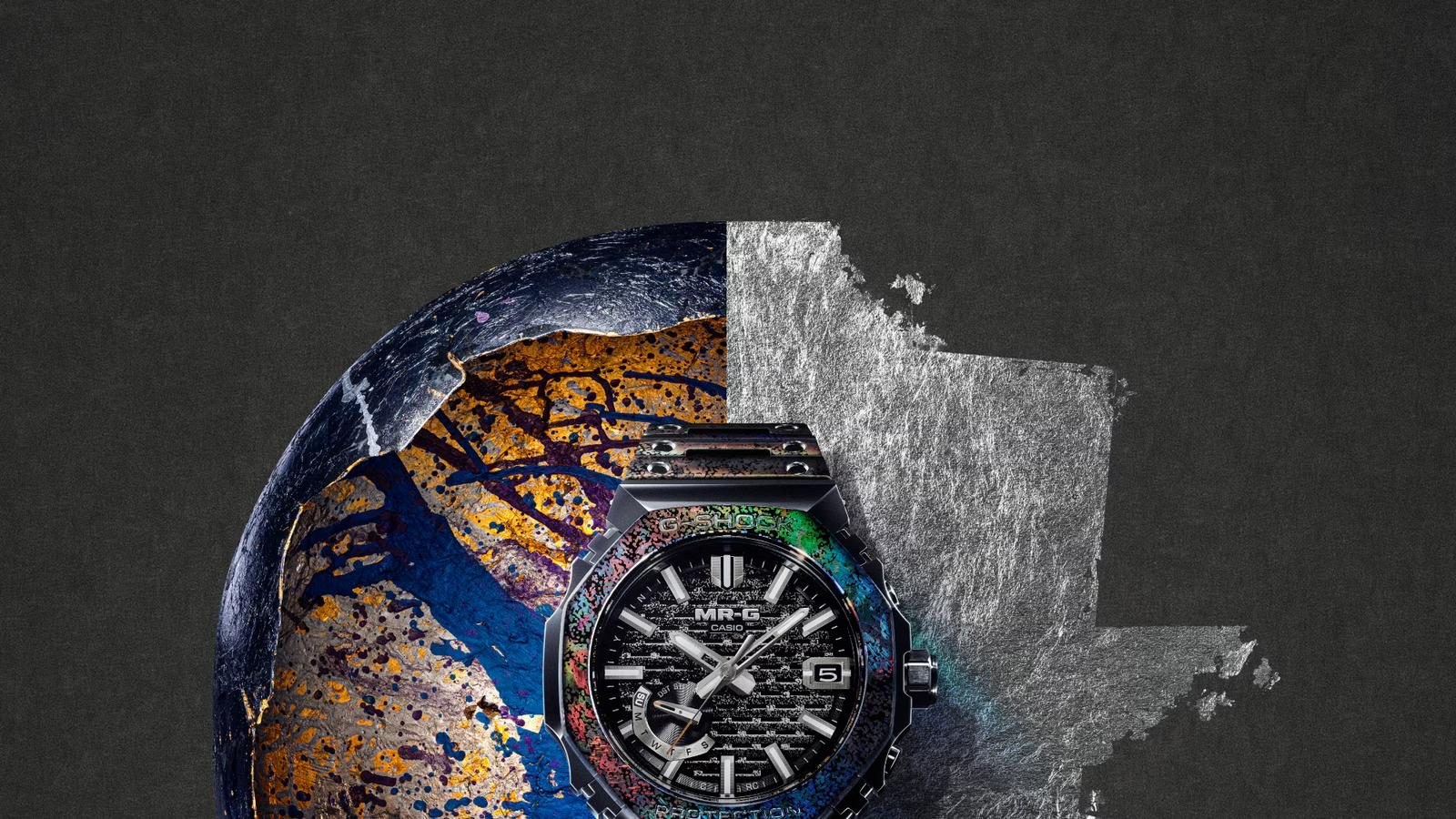
 uying a digital watch for seven grand is a stunt that requires either a serious collector's diagnosis or total indifference to your bank balance. And we aren't talking about Swiss mechanical heritage with centuries of history and hand-assembled tiny gears; this is a Japanese quartz instrument in a titanium case that cannot even brew you a cup of coffee for that price.
The mechanics here are simple: the Japanese manufacturer is selling not so much the time as the thirtieth anniversary of its high-end MR-G lineup and a strictly limited run of 800 pieces worldwide. Every buyer gets an individual serial number so they can easily explain to their friends why a chunk of metal on their wrist costs as much as a used sedan. Sales of the MR-G B2100 kick off in November 2026, and judging by the 1.1 million yen price tag (around $6,928), you shouldn't expect queues of practical people outside the stores.
The company's main excuse for the price is the manual labor and exotic materials processing, which the average owner of a hundred-buck plastic G-Shock would likely view with a nervous twitch.
The standout feature of the model is its dial, crafted in collaboration with Kyoto metal foil artisan Hiroto Rakusho.
Workers manually apply an ultra-thin layer of platinum to the lattice base of this dial, meaning the surface pattern and light reflection will differ slightly on every single watch. Instead of standard paint, the case and bracelet are treated with ultra-short laser pulses that carve out a microscopic relief for light play, mimicking the optical effect found on butterfly wings.
Thanks, Captain Obvious—the exact same set of functions, including 200-meter water resistance and five months of battery life thanks to solar charging, is available in models ten times cheaper.
There is only one counter-argument, and it boils down to common sense: for seven thousand dollars, you get a quartz watch whose timekeeping accuracy is corrected via radio towers or a smartphone, yet one that demands careful handling because of its collector status. Shock resistance is still there, but only a blogger with solid insurance is going to test it with a hammer on a watch featuring platinum dusting by a Kyoto master.
At the end of the day, we are looking at a souvenir for brand superfans who are ready to overpay for the handiwork of Kyoto craftsmen. This purchase has about as much practical sense as a gold-plated toilet: it tells time just as well as the model from your local sports store for a hundred bucks, only the hole in your budget looks a whole lot bigger.