
 ost biometric security sold to homeowners is little more than a polite suggestion. Optical and capacitive fingerprint readers remain embarrassingly easy to fool with lifted smudges, silicone molds, or simple residual oil on the glass. Maker Sachin Soni at Techiesms took a significantly more rigorous approach, building a homemade door lock that bypasses surface-level skin entirely to scan the subcutaneous vascular map inside your palm.
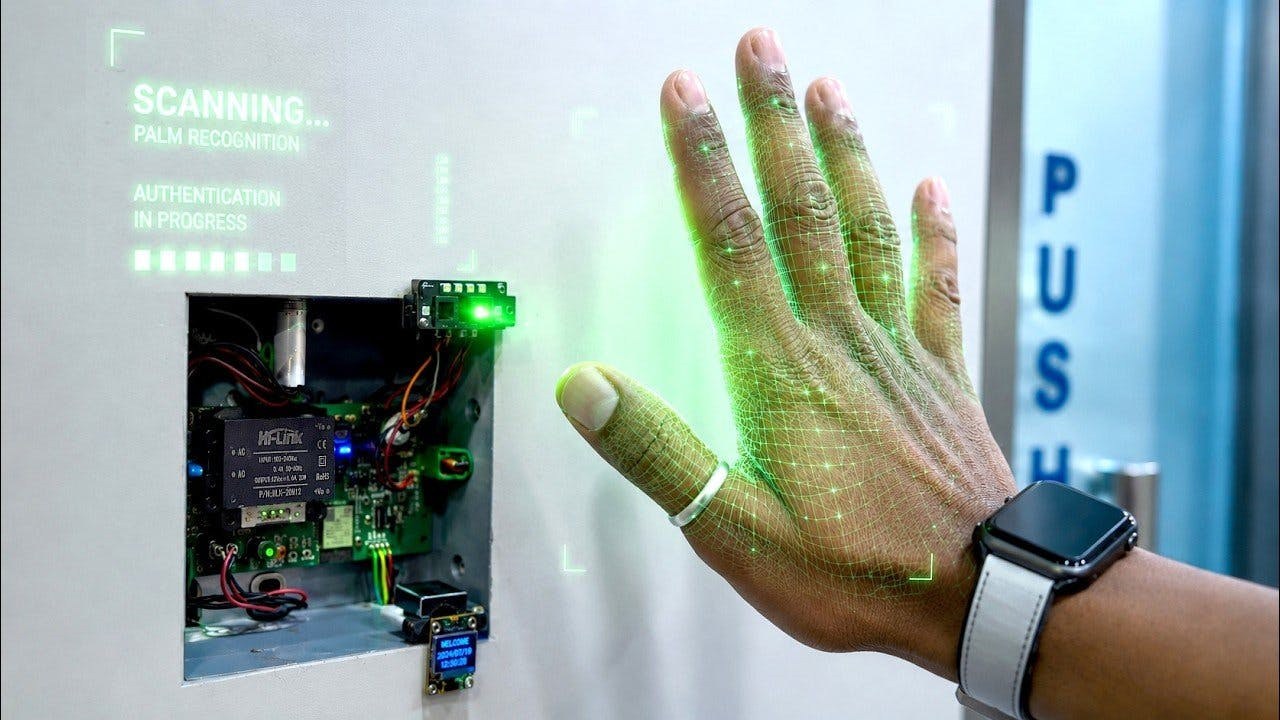
As Cameron Coward reported for Hackster News, the core scanning physics are remarkably robust against casual forgery. The system runs on a specialized DFRobot dual-camera module bathed in infrared illumination. Deoxygenated blood in your veins absorbs infrared light while surrounding tissue reflects it, generating a high-contrast internal vascular map. Unlike fingerprints left on a glass tumbler or a high-res facial snapshot grabbed from social media, you cannot clone someone's internal circulatory system without their direct, active cooperation.
The Hardware Vulnerability
To translate that optical feed into physical latch control, Soni fabricated a custom carrier board pairing an ESP32-WROOM-32E microcontroller with a relay, an OLED status panel, and a standard door solenoid. The heavy biometric processing runs on the DFRobot module's onboard processor, which transmits a raw unlock signal over an unencrypted UART serial line to the ESP32.
The promise of biometric security is, in large part, a farce when the wiring sits outside the door.
Here lies the classic maker pitfall: fortifying the biometric front door while leaving the electrical back door wide open. A burglar has zero incentive to clone your vascular tree when they can simply pop the plastic housing, tap the raw UART line to replay an unlock command, or short the relay terminals with a screwdriver. Biometric verification under the skin is practically unpickable, but unless the microcontroller, relay, and data lines live strictly inside the armored side of the door jamb, you have simply traded a lockpick for a wire stripper.