
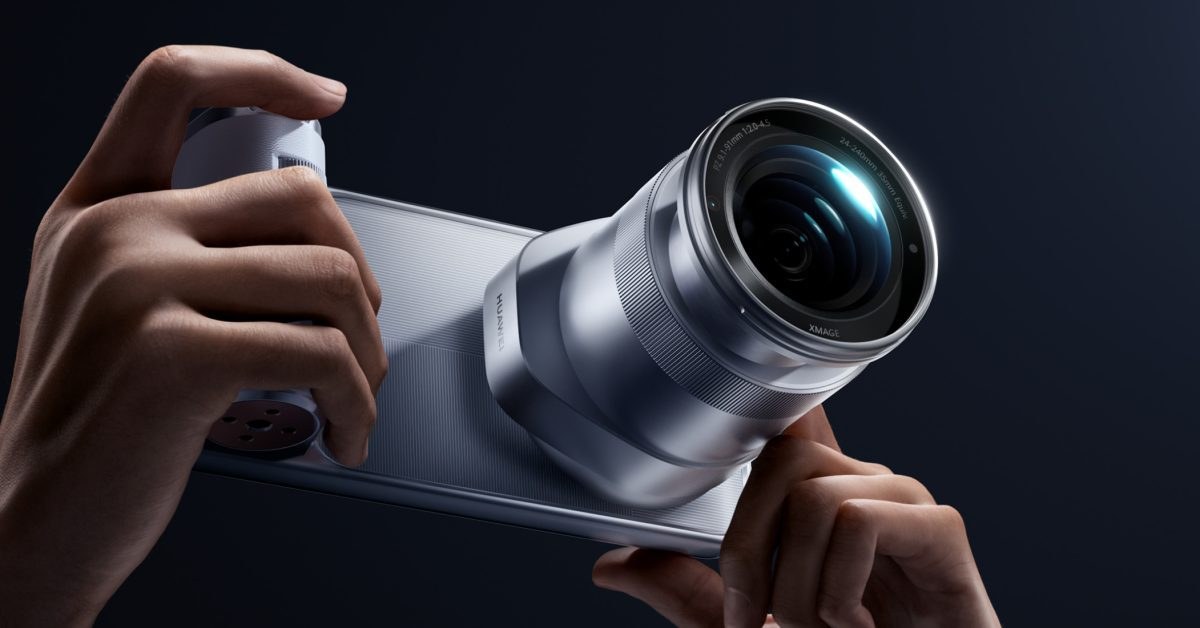
 uawei has rolled out its Mate 90 Pro Max in China, dragging back an idea the mobile industry happily dumped years ago: the modular camera attachment. Instead of trusting built-in optics, the device pops open to swallow a massive physical lens setup, transforming a standard smartphone into a bulky hybrid. The phone itself packs a 6.9-inch dual-layer OLED screen, an in-house Kirin 9050 chip, Harmony OS 7.0, up to 16GB of RAM, and a hefty 6,800 mAh battery, all wrapped in IP68/69 protection. Even without attachments, the built-in photography array handles business with a 50MP main shooter sporting a variable aperture, a 40MP ultrawide, a 200MP telephoto lens with 4x optical zoom, and a 13MP front-facing setup tucked behind three cutouts.
Yet the real anchor here is not what sits flush inside the glass chassis, but the monstrous 5,999 CNY add-on camera known as the Z10, translating to about $900 USD. The phone itself runs 9,499 CNY, or roughly $1,400, and both hit shelves this week in China. Snap the Z10 onto the back using Huawei’s HyperClick mount, and you are bolting on an entire separate camera system featuring a 1-inch sensor, up to 10x optical zoom, and a massive detachable lens that covers the phone's original glass entirely.
The cost of the add-on “Z10” camera is 5,999 CNY, around $900 USD.
Why Carry a Separate Lens
According to Huawei, the pitch is simple: a multi-lens optical system delivering a 24mm-240mm focal length, continuous 10x optical zoom, and a maximum aperture of F2.0-F4.5, all paired with that 1-inch sensor for serious imaging power. Much like the built-in hardware, this add-on relies on an RYYB sensor hitting 50MP, shifting seamlessly between focal ranges. The HyperClick mount locks everything down with a single click, letting you share images straight from the device after shooting.
This entire setup tries to punch through the stubborn physical limits of slim smartphone bodies by dragging heavy hardware back into the picture. Mobile sensors have grown as large as engineering allows within flat glass sandwiches, but optics still demand deep barrels and massive glass elements. By bolting a standalone camera onto a phone, Huawei sidesteps the thickness barrier entirely.

Who Needs This Compromise
Before you empty your wallet for a phone that costs $1,400 plus an extra $900 for a lens module, take a hard look at what you are actually carrying. Tacking a massive chunk of glass and a dedicated 1-inch sensor unit onto a device with a 6,800 mAh battery completely ruins the core convenience of a pocket computer. You get professional focal lengths stretching up to 240mm, but you surrender the one thing smartphones were built for: the ability to slide into a pocket without pulling your trousers down.
It reads as an idea built purely for the sake of an idea, designed to show off engineering muscle rather than solve a daily annoyance. The market left modular cameras behind for a reason, and a heavy, expensive metal brick does little to prove it was wrong.