
 f you have ever tried to play a demanding game with a laptop on your lap, you surely remember the sensation of a searing skillet and the turbine roar of a jetliner taking off. Manufacturers promise efficient heat dissipation in thin chassis year after year, but physics is stubborn, and aging hardware invariably begins throttling right in the middle of a match. YouTube hardware modder TrashBench decided to permanently settle the debate by strapping a full-sized desktop water-cooling rig to a portable machine.
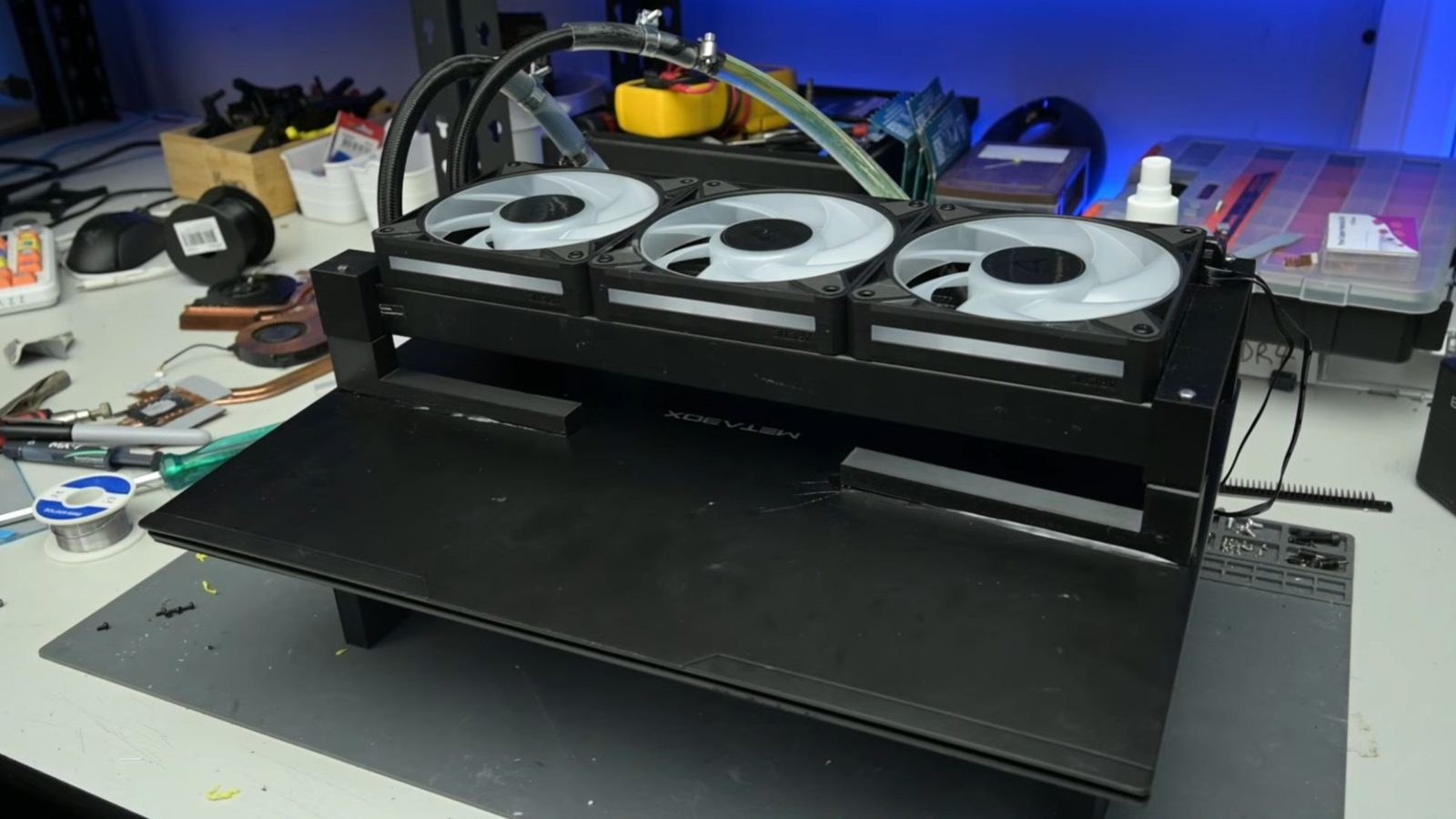
YouTube hardcore PC modder TrashBench attached waterblocks, a water pump, and a 360mm radiator to a Metabox laptop.
For the experiment, the enthusiast grabbed an Australian Metabox laptop—essentially a rebranded Clevo chassis sourced from Taiwanese manufacturing lines used by brands worldwide. Hidden inside this particular specimen lived an Nvidia GTX 1060 graphics card and an Intel Core i7-8750H processor.
How to build a mobile Frankenstein
Modifying the chassis required severe structural surgery. Waterblocks were mounted using a custom 3D-printed bracket attached directly to the screw holes originally meant for the factory heat pipes and cooling fans. Because the oversized radiator refused to fit beneath the display panel, the modder strapped it to the back of the lid using Loctite epoxy since standard mounting points were completely out of the question.
The modified laptop dropped a whole 60℃ on both the CPU and GPU during benchmarks and stress tests.
Other thermal vulnerabilities did not escape attention either: system memory and power delivery components received individual heatsinks secured with thermal pads and drops of epoxy, making the upgrade entirely irreversible. Power for the pump and fans arrived via a step-down voltage regulator soldered directly to the stock fan headers. To operate the cooling loop independently from the motherboard's power logic, TrashBench drilled a mechanical toggle switch right into the plastic bottom panel. The final touch was a 3D-printed pedestal keeping the entire monstrosity rigidly planted on a desk.
Performance gains and the harsh financial reality
Benchmarks highlighted by Tom's Hardware confirm that the extreme surgery delivered genuine technical results. During stress tests, CPU and GPU temperatures plummeted by an astonishing 60 degrees Celsius. That massive thermal headroom allowed for a healthy overclock, pushing overall gaming and benchmark performance up by an average of 14%.
As a practical demonstration in Forza Horizon 5, frame rates climbed from 75 to 77 fps, eventually hitting 83 fps after applying the overclock. The modder even intends to hand the modified machine down to his daughter for Fortnite sessions. However, for anyone browsing store shelves today, this approach makes zero practical sense because portability has been entirely eradicated. The laptop has transformed into a stationary desktop system tethered by rigid tubing and a massive radiator, completely defeating the point of having a portable computer in the first place.
Spending hours hacking up a plastic chassis with epoxy just to claw back a dozen extra frames in ancient games is a dead end for anyone buying a computer for actual work or travel. If you need a dedicated desk and a constant wall outlet, you are infinitely better off buying a proper desktop tower. These elaborate experiments belong strictly in the garages of eccentric tinkerers, while ordinary buyers are far better off waiting for factory designs that do not require glue residue on the lid.