
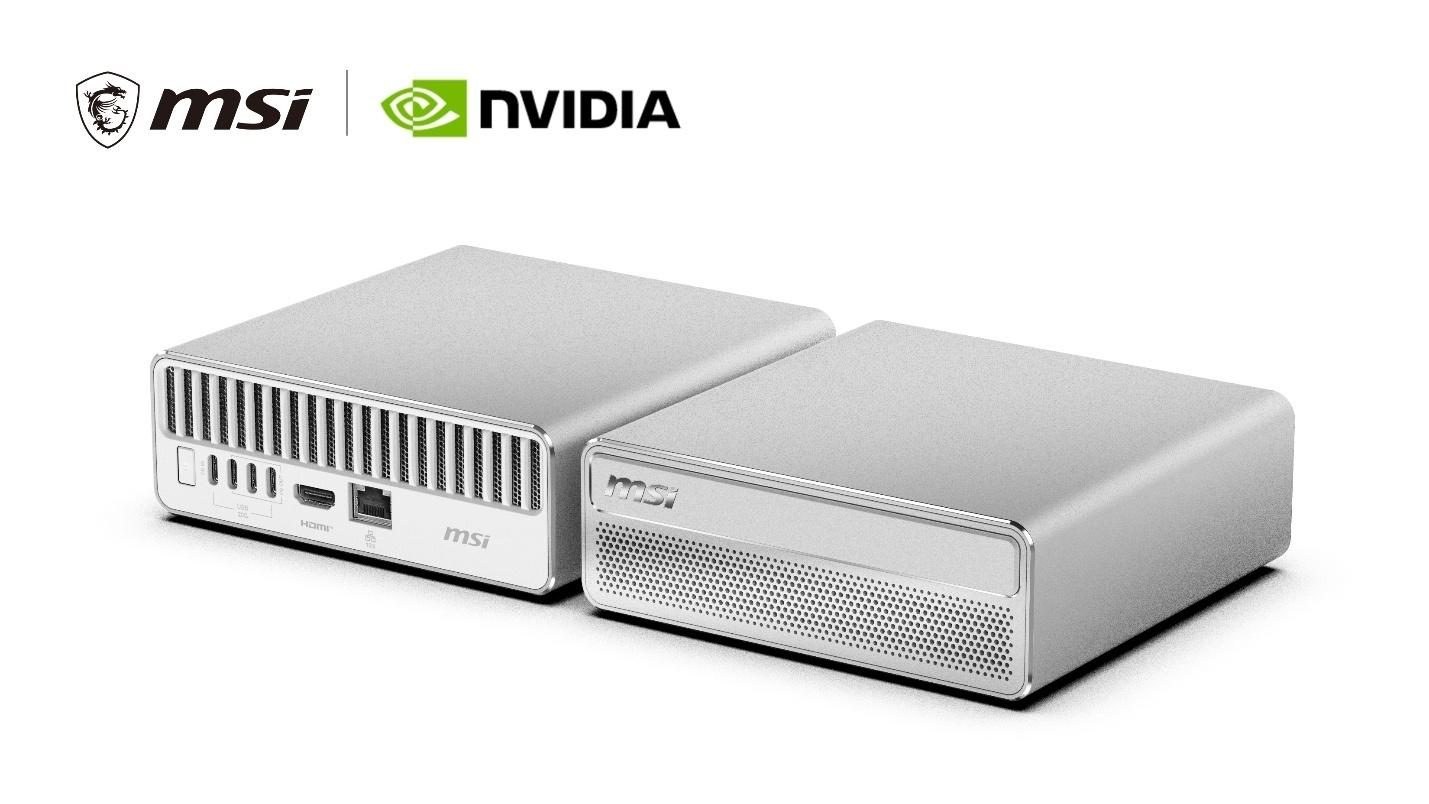
 hile cloud giants suggest renting someone else's capacity for working with artificial intelligence, hardware manufacturers are taking another route by trying to put a server right on your desk. MSI has introduced the compact EdgeMesa N AI+ computer with a volume of just 1.3 liters, promising workstation-level performance without sending data to the cloud.
Behind the familiar mini-PC format lies heavy artillery: the device is built on the Nvidia RTX Spark platform and equipped with 128 GB of unified memory. The manufacturer claims it can run models with 120 billion parameters. For a private buyer, this sounds tempting, but the actual viability of such an investment raises questions, given that the price tag for such devices will inevitably cross all reasonable boundaries for a home budget, turning local experiments with neural networks into an unjustifiably expensive luxury.
What's inside this box
At the heart of the computer is the RTX Spark N1X superchip, combining a 20-core Grace processor and a Blackwell graphics chip with 6,144 CUDA cores. As MSI stated, peak performance for FP4 calculations on sparse AI models reaches 1 petaflop, though any numbers from a vendor always require verification by independent tests.
The device is built on the Nvidia RTX Spark platform and equipped with 128 GB of unified memory.
LPDDR5X-9600 memory with a capacity of 128 GB is shared between the central and graphics processors, bypassing the limitations of traditional video memory. The system supports a context window of up to 128k tokens, while data storage is handled by an NVMe SSD slot up to 4 TB. Against the background of current market component costs, this amount of fast memory in a compact chassis means colossal purchase expenses that will only pay off for narrow specialists who make a living from local development.
Noise, cooling and real life
Cooling the tiny chassis is handled by an air cooling system and a vapor chamber, while power is supplied by an external 240W adapter. On paper everything looks smooth, but you have to pay for compactness: the declared noise level is 28 dB at idle and up to 32 dB under full load, and under prolonged pressure the silicon will inevitably hit a thermal barrier.
Cooling is handled by an air cooling system and a vapor chamber, while power is supplied by a 240W adapter.
Interface options include four USB-C ports with speeds up to 20 Gbps, three of which support DisplayPort 1.4 Alt Mode, HDMI 2.1b, and 10GbE Ethernet. Wi-Fi 7 and Bluetooth 5.4 are also available, and image output is possible simultaneously to four displays, turning this server into an overkill tool for everyday tasks.
Buying a home server in a mini-PC chassis for the sake of local neural networks makes zero sense for an ordinary user, as the exorbitant price of the device makes such an investment economically pointless for a home office.