
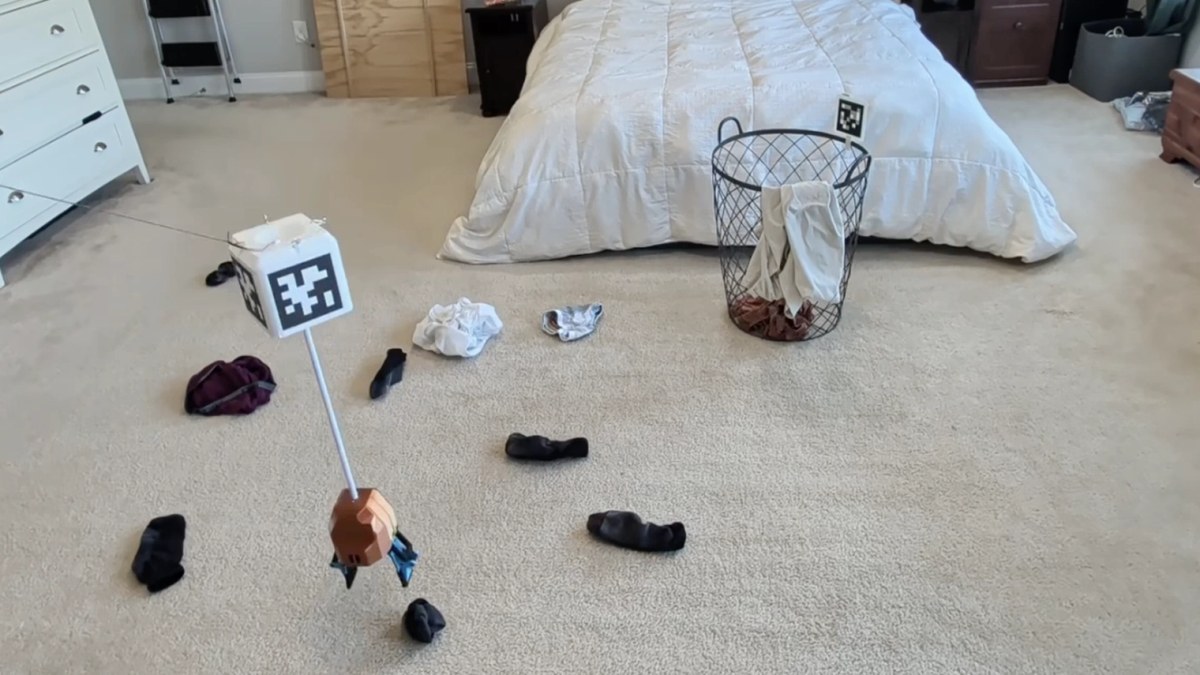
 uspending live electric cables across your living room so a mechanical gripper can pick up stray socks sounds like an invention straight out of a mad scientist's garage. While traditional robot vacuums helplessly spin their wheels on door thresholds and choke on charging cords, startup Neufangled decided to tackle the problem from above by hanging a robotic manipulator on suspended cables right beneath the ceiling.
This is an ambitious attempt to replace conventional wheels with industrial cable-driven kinematics—the exact same technology used for stadium skycams and heavy-duty warehouse gantry systems.
A web beneath the ceiling
The operating principle behind the Stringman is straightforward on paper: four corner anchors mount to the walls, suspending tensioned cables between them. A robotic carriage with a two-finger gripper moves along this cable network. The developers claim the system can cover rooms up to 12 meters diagonally, roughly spanning an 8x8x3-meter space. This aerial robotic hand can lift objects weighing up to 2 kilograms, which is more than enough for a coffee mug, a discarded T-shirt, or a toy car.
For navigation, the system relies on three cameras: two integrated into the corner mounts and a third installed directly on the manipulator's wrist. The gripper itself features a pressure sensor, a laser rangefinder, and gyroscopes to regulate grip force and prevent crushing fragile objects. When idle, the Stringman parks neatly against the ceiling, keeping floor space clear. While the creators promise setup or teardown takes just five minutes, real-world living rooms with ceiling lights and chandeliers will likely turn that into a far more complicated task.
Tethered to a PC with electrified wires
Strip away the polished pitch, and severe engineering compromises quickly emerge. The system delivers 24-volt power directly through the exposed load-bearing cables. The package thoughtfully includes a wireless emergency stop button—presumably in case an adventurous cat decides to pounce on the high-tension web.
Power is delivered directly through the load-bearing cables at 24 volts; a wireless emergency stop button is included in the box.
Calling this a finished consumer appliance is a stretch. Inside the suspended module sits a modest Raspberry Pi Zero 2W, while the heavy lifting—motion planning and computer vision—demands a dedicated external computer running Linux or macOS with at least a six-core processor. Control options include a web interface with 3D visualization, a standard gamepad, Python scripts, or the open-source Lerobot framework. For robotics researchers collecting training datasets for AI models, it is a versatile platform; for everyday consumers, it is an impractical hurdle.
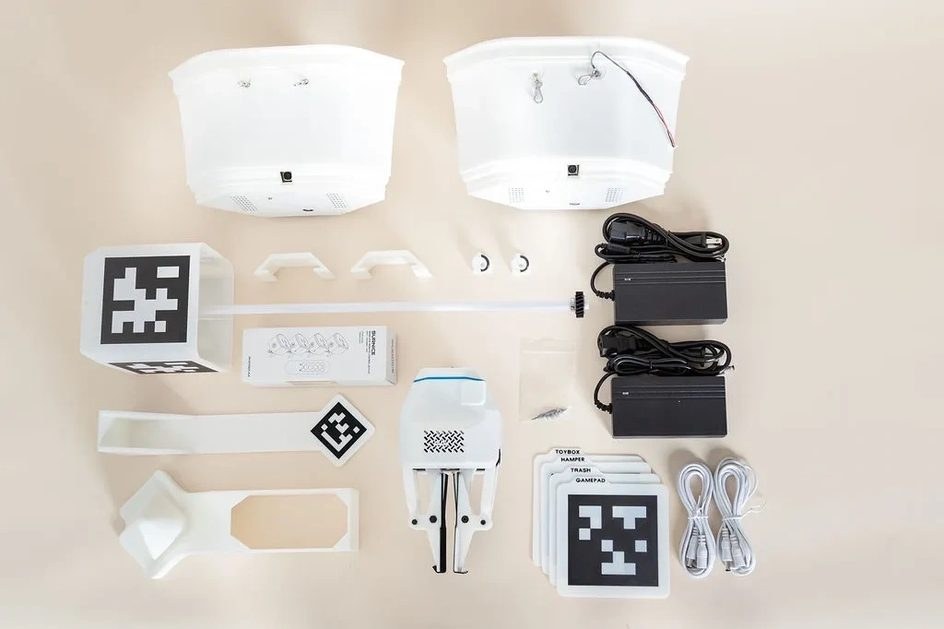
Priced at $965, the package is far more of a research kit than an autonomous home helper. Neufangled also offers a cheaper DIY kit with 3D-printed components for budget-minded tinkerers. By 2027, the company aims to release a second-generation model called Arpeggio, promising an articulated wrist and motors with an eightfold boost in torque.
Buying the Stringman to handle daily chores makes little sense today. Live wires stretched across the room, pet safety hazards, and the requirement of a running desktop PC easily outweigh the novelty of an automatically retrieved sock. It serves as a fascinating experimental testbed for engineers, but it remains entirely out of place in an ordinary home.
Key takeaways
- Neufangled introduced a novel cable-driven robotic arm capable of lifting up to 2 kg across large rooms.
- Domestic trade-offs currently outweigh convenience, including exposed 24V cables and collision risks.
- The system requires an external six-core PC, manual calibration, and ongoing control via gamepad or custom scripts.