
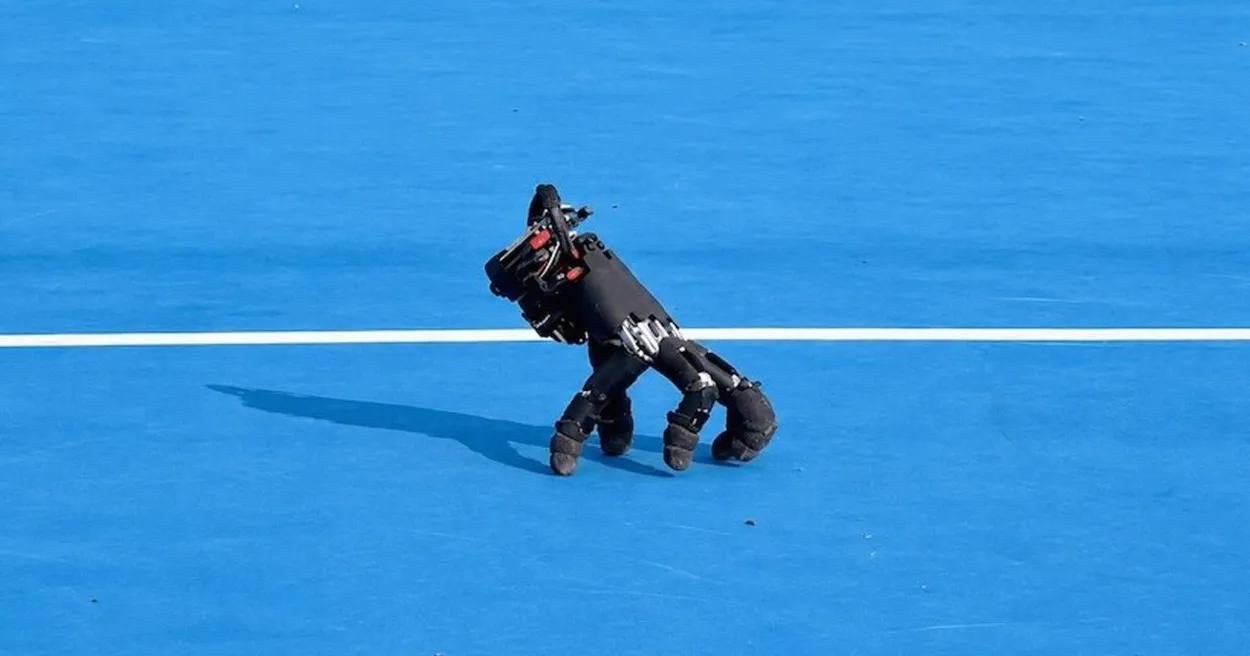
 hile engineers argue over how many wheels and tracks a home robot needs to avoid getting stuck in the narrow corridor between the wardrobe and the cat bowl, Swiss researchers decided to get rid of the chassis altogether. Imagine a standard robotic arm that, instead of rolling or heavily shuffling clumsy legs, stands on its own fingertips and briskly stomps across the apartment. It sounds like the setup for a horror movie about a kitchen utensil uprising, but this is entirely serious scientific work.
Behind this design are scientists from the Soft Robotics laboratory at ETH Zurich, who made a standard robotic hand move on fingertips of different lengths without altering its design. The device can independently maintain balance without any platforms or additional supports. Stripping away the usual marketing fluff, this is an attempt to teach robots to sneak where ordinary wheeled carts simply won't fit.
How to make a metal hand walk
- The funniest part of this story is that the creators didn't redesign the hardware for the new task. For the experiments, they used an off-the-shelf humanoid robotic hand, and the scientists didn't change the finger lengths or the built-in position controller. The engineers had to tackle the problem head-on: human fingers naturally have different lengths, so when moving across a surface, the hand constantly has to account for their geometry while maintaining stability. To make the system autonomous, a battery and a computing module were added to the hand, freeing it from dangling wires and tethering to external computers.
To make the system autonomous, a battery, a computing module, and a set of sensors were added to the hand.
The control algorithm was trained in a virtual environment using reinforcement learning, feeding simulation after simulation to the artificial intelligence until the virtual hand learned to balance. During testing, the hand managed to move across more than a dozen different flat indoor and outdoor surfaces, confidently handling tile, grass, and stone. The surfaces had varying friction coefficients, forcing the robot to adjust its finger movements on the fly depending on the conditions.
Why you actually need this
Autonomous movement is useful not so much in itself for creating wandering hands, but for systems operating in tight spaces. The mechanics of the process look like this: a large robot can leave the hand on a support surface near a narrow opening, after which the hand will independently reach a control element or object located inside, perform the necessary action, and return back. This approach allows the main system not to shove an entire massive arm or bulky manipulator into a hard-to-reach area.
During the experiments, the robot not only walked across various surfaces but also pressed individual computer keys, independently playing a round of the Sokoban puzzle. The hand took turns pressing the arrow keys and beat a level of the computer game, proving that it is capable not just of getting from place to place, but of interacting precisely with interfaces. The authors of the work believe that native mobility can make robotic hands more versatile when working in spaces and with technology originally designed for humans.
Key takeaways
- Researchers from Zurich taught an ordinary robotic hand to walk on its fingertips thanks to software and autonomous power, paving the way for compact home assistants.
- The system uses a standard off-the-shelf robotic hand without hardware modifications, relying purely on reinforcement learning algorithms.
- During tests, the hand successfully navigated tile, grass, and stone surfaces with varying friction.
- Beyond simple locomotion, the hand demonstrated precise manipulation by playing a computer game using keyboard arrows.
Strategic context
Traditional home and industrial robots rely on bulky wheeled chassis, tracks, or multi-jointed legs that require significant clearance. By turning the manipulator itself into a mobile unit, this research bypasses the physical footprint limitations of classic robotics, pointing toward modular systems where tools can detach and crawl into restricted spaces independently.
Key takeaways
This is a fascinating peek at a future where robotic limbs don't need a heavy vehicle body to get around. While it's still lab-bound, teaching a standard hand to tiptoe across gravel and play puzzle games on a keyboard is a remarkably pragmatic step toward genuinely useful, space-saving domestic hardware.