
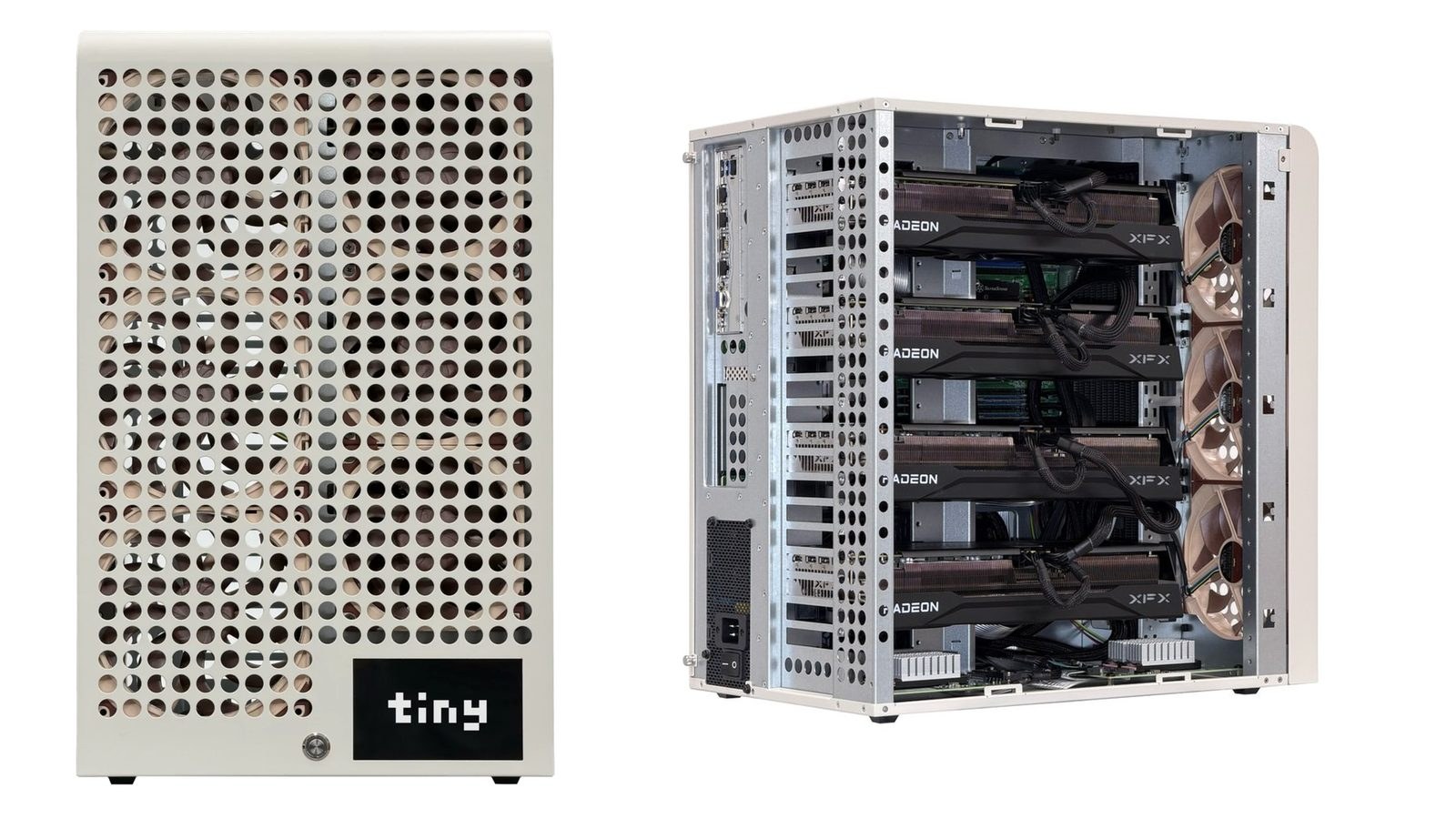
 f you want to train neural networks at home without renting cloud servers, you are staring at a very lonely hardware market. The latest attempt to solve this problem comes from Tinygrad, which has refreshed its desktop deep-learning workstation, the Tinybox, with support for four AMD Radeon RX 9070 XT graphics cards, as TechRadar reported. At an $11,000 starting point for that specific layout, the machine looks like a dream for independent developers who want to escape monthly cloud bills. But before you open your wallet, it helps to look closely at what you are actually buying: a collection of older enterprise server parts packaged into a massive metal box that weighs 42 pounds and measures 12 inches wide, 19.25 inches high, and 18 inches deep, according to TechRadar.
Here is the catch that changes everything for your budget. To keep the base cost down while still feeding four power-hungry graphics cards, Tinygrad built the standard G4 platform around a 32-core AMD EPYC server processor running on older DDR4 memory and PCIe 4.0 connectivity, as TechRadar documented. That means you are paying top dollar for a brand-new machine powered by yesterday's silicon infrastructure. If you want modern standards like DDR5 memory and PCIe 5.0 speed, you have to look at the G5 platform, which starts at $12,000 before you even add a single graphics card, memory stick, or storage drive, per TechRadar's specification breakdown.
Paying Premium Prices for Yesterday's Silicon
The economics of local hardware versus cloud rental rarely favor the buyer unless you are running your workloads continuously around the clock. Tinygrad prices the base G4 platform at $7,000, and adding four Radeon RX 9070 XT graphics cards tacks on another $4,000, bringing the total configuration to $11,000 before any optional upgrades, as noted by TechRadar. If you prefer Nvidia hardware, the numbers escalate rapidly: configuring the workstation with a single RTX 5090 costs an additional $8,000, two of them cost $16,000, and professional RTX 6000 options run $19,000 individually or $38,000 for a pair, according to TechRadar.
“Everything old is new again. We're reentering an era where there are programs people want to run but can't because their computers are too small.”
Upgrades do not get any friendlier to your bank account. Bumping the system memory from 32 gigabytes to 128 gigabytes costs an extra $3,000, while storage options range from a four-terabyte RAID array for $2,000 to a 16-terabyte RAID array for $6,000, per TechRadar's pricing details. When critics called out these steep prices, as reported by TechRadar, a Tinygrad spokesperson responded bluntly, saying, “We strongly encourage others to compete with us.” When you factor in that Tinygrad builds each workstation to order with delivery windows ranging from one to eight weeks, you realize this is a boutique garage-workshop product, not a mass-market appliance.
The Verdict on Local AI Workstations
Building a heavy-duty local machine makes sense only if you despise cloud subscriptions and have workloads that would bankrupt you on rented server time. But packing a workstation with enterprise server hardware from older generations while charging five-figure sums exposes the harsh reality of independent hardware manufacturing. For anyone hoping for an affordable shortcut into local artificial intelligence development, this machine is a harsh reminder that bypassing the cloud is an expensive luxury. An expensive toy for die-hard enthusiasts, not a sensible tool for your desktop.