
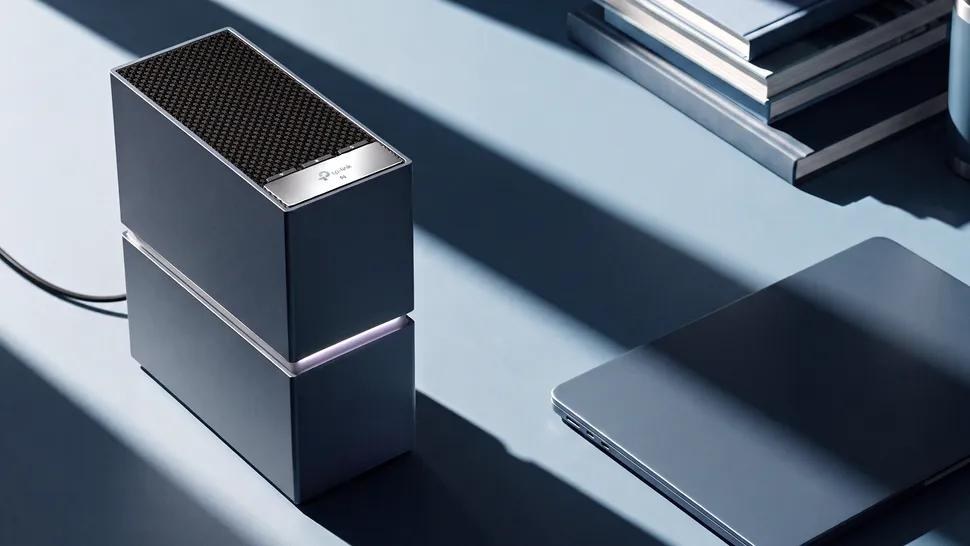
 wenty-two gigabits per second—that is the eye-catching figure TP-Link showcased when announcing the world's first Wi-Fi 8 devices. The company revealed the standalone Archer 9 Ultra router and the Deco 8 Ultra mesh system, targeting a retail launch on September 30. On paper, the specs look massive: the Archer 9 Ultra bristles with 18 antennas, while the Deco kit promises to blanket a mammoth 9,800 square feet (910 square meters) and support over 200 active devices.
Looking past the marketing sheen reveals a premature release driven by PR. The advertised peak throughput immediately runs into regional regulatory walls. While the US version of the Deco 8 Ultra touts up to 22 Gbps across three bands (including 6 GHz), the European variant is capped at 19 Gbps. The single Archer 9 Ultra delivers up to 19 Gbps, covering roughly 3,600 square feet in the US and 3,000 in Europe.
Bandwidth with nowhere to go
In practical terms, you will not experience these speeds on your everyday devices, no matter how much you spend on the hardware. Current smartphones, tablets, and laptops simply lack Wi-Fi 8 chipsets.
"The defining upgrade of Wi-Fi 8 is not raw speed. Unlike Wi-Fi 7, the new standard focuses primarily on ultra-reliable connectivity."
Until the broader consumer electronics market rolls out next-generation client hardware, this expensive networking gear will fall back on older wireless protocols. You will see zero real-world speed improvement in daily tasks.
TP-Link counters this skepticism by emphasizing link stability. The hardware integrates StabilityEngine, dynamic bandwidth allocation, redundant channels, and Multi-Access Point Coordination (MAPC) to fight interference and packet loss. While technically robust, this level of engineering is overkill for most households. Residential internet plans rarely exceed 1–2 Gbps, and existing Wi-Fi 6 or Wi-Fi 7 setups already provide more than enough headroom for modern smart homes.
If your home internet feels sluggish, hold off on funding early-adoption marketing—optimizing your existing router's settings and physical placement remains the far smarter first step.