
 ech giants want you to believe that artificial intelligence is impossible without gigawatt data centers and billions in venture capital. That convenient myth sells cloud subscriptions, proprietary accelerators, and endless enterprise licenses. As developer Sean Lavigne proved with his MacMind project, the core mechanics of modern neural networks are not esoteric secrets locked behind corporate server racks. They are pure, accessible math—and they run just fine on a beige box from the late Cold War era.
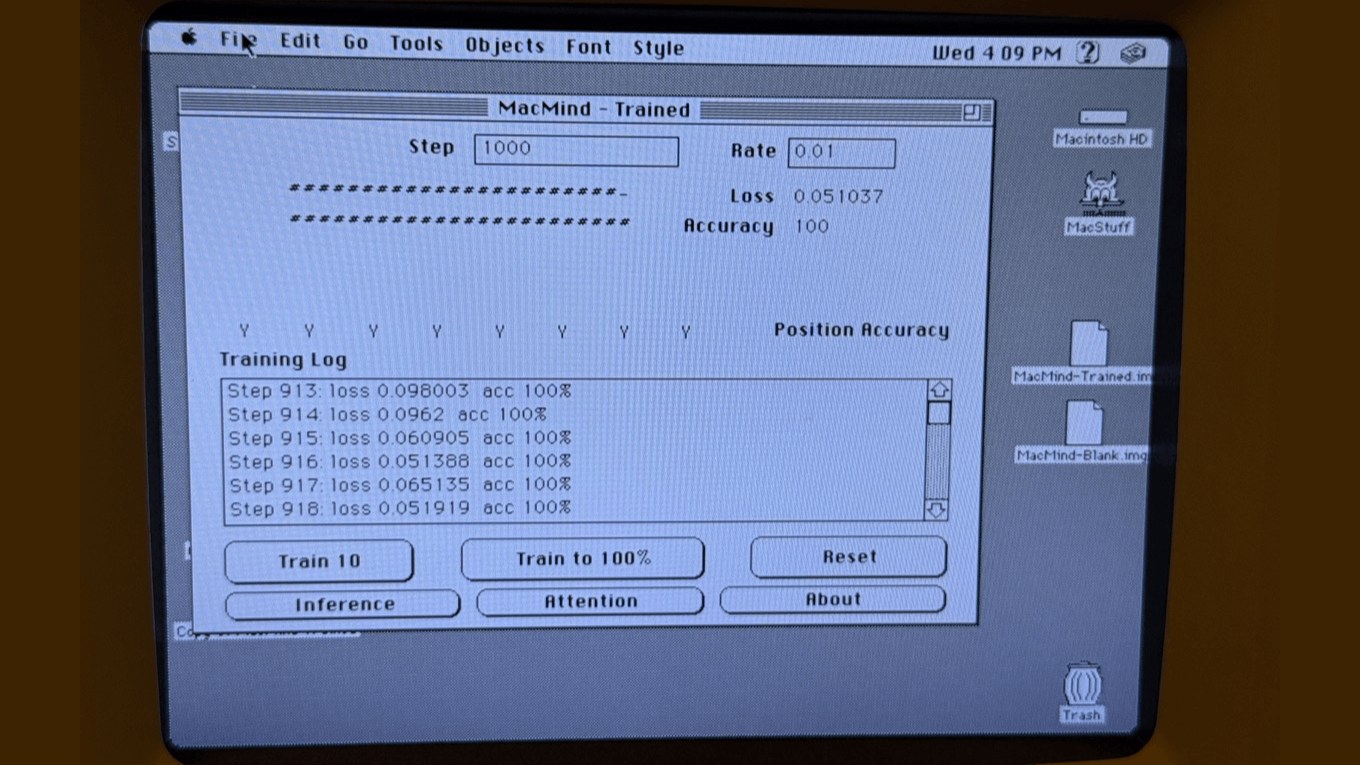
Lavigne built a fully functional transformer neural network on a 1989 Macintosh SE/30. Instead of leaning on modern Python frameworks, he wrote the entire architecture from scratch in HyperTalk, the quirky scripting language powering Apple's HyperCard. Every textbook component found in cutting-edge large language models is present in the code: token embeddings, positional encoding, scaled dot-product self-attention, cross-entropy loss, backpropagation, stochastic gradient descent, and residual connections.
HyperCard Strings Versus Modern Arrays
Executing modern transformer mechanics on a 16 MHz Motorola 68030 processor naturally runs into physical reality. The model contains just 1,216 parameters distributed across six weight matrices, making it microscopic compared to commercial systems. Because HyperTalk lacks native array data types, Lavigne had to store each weight matrix as a comma-separated string inside hidden HyperCard fields, forcing the machine to parse text strings character by character for every single calculation.
Watching a 16 MHz Macintosh rediscover an algorithm that has been fundamental to digital signal processing for decades is an impressive demonstration of what even a tiny neural network can accomplish.
Despite the brutal hardware bottleneck, the fundamental training process mirrors modern multi-billion-parameter clusters step for step: run a forward pass, compute loss, backpropagate errors, update weights, and repeat. The network was tasked with discovering the bit-reversal permutation, a critical foundation of the Fast Fourier Transform algorithm. Rather than being hardcoded with the rules, MacMind analyzed training examples and derived the logic independently. After training, the model converged cleanly, drawing the classic butterfly routing pattern directly on its attention map.
Open Architecture You Can Actually Touch
The entire setup runs as an interactive five-card HyperCard stack where users can train the network, run inferences on custom inputs, inspect attention maps, and follow the math through plain-language breakdowns. Anyone curious can option-click the interface buttons to inspect the raw HyperTalk source code, tracing every single matrix multiplication directly on vintage silicon.
MacMind strips away the breathless corporate mystique surrounding artificial intelligence to expose the straightforward arithmetic underneath. Industrial scale makes models fast and versatile, but the core logic requires surprisingly little to function. Understanding how transformer architectures actually work does not require leasing an H100 cluster when a 35-year-old desktop can teach you the exact same foundation.